Oil Corridors Under Fire as Trump Waives Russia Sanctions
Escalating strikes near critical energy chokepoints collided with a surprise U.S. waiver on Russian oil penalties, exposing deep fractures in Western strategy.
Later readings
Saudi Oilfield Strike Shatters Calm as Diplomacy Stumbles
22 October 2026Fatal drone interception in the Gulf exposes energy risks while fragile peace overtures fail to halt fighting in Ukraine.Choke Points Flare as War Threats Spread
21 October 2026Military moves in the Black Sea and the Gulf signal deepening risks for global trade.Gulf Chokepoints and Yemen Strikes Strain Fragile Diplomacy
20 October 2026A deadly training camp strike and unverified tanker threats pushed oil past $110 as global peace talks stalled.Global Crises Converge on Key Energy Corridors
19 October 2026Escalating regional clashes and border incursions raise supply disruption fears worldwide.
In a nutshell
Sharply tense (−64) — unchanged since the previous reading. Pressure: Yemen crisis (−88) and Iran nuclear program (−85). The biggest swing: Lebanon security and armed-group containment, +39 since the previous reading.
Highlights
- Brent crude · price: 109.86 USD/bbl (+5.14 vs a week ago)
- Drewry World Container Index · value: 4485 USD per 40ft (+134 vs a week ago)
- EU natural gas (TTF) · price: 87.547 EUR/MWh (+8.64 vs a week ago)
- Gold · price: 4165.12 USD/oz (−29.24 vs a week ago)
The score of every gauge
−100 … +100- The needle starts at 0 at the top: right in blue for a plus, left in red for a minus, the ticks counting the way from 0; a dashed scale is quiet.
- Score — −100 maximum stress … +100 calm
Where the activity was
0–100| Ukraine-Russia war | 95 |
|---|---|
| Yemen crisis | 95 |
| Supply chain tensions | 90 |
| Iran nuclear program | 88 |
| US trade policy | 87 |
| Israel-Palestine conflict | 82 |
| Africa conflicts | 82 |
| NATO & transatlantic ties | 79 |
| EU-China trade dispute | 74 |
| EU-Russia relations | 70 |
- How much happened to each gauge in this window, 0–100.
- Activity — 0–100
- Activity is not direction: a busy gauge can be calm, a quiet one tense.
Every gauge, measured
| Gauge | Score | vs a week ago |
|---|---|---|
| US–China trade war | quiet | — |
| Taiwan tensions | quiet | — |
| Technology competition | −35 | flat |
| Ukraine-Russia war | −82 | flat |
| EU-Russia relations | −65 | −22 |
| Israel-Palestine conflict | −73 | −34 |
| Iran nuclear program | −85 | flat |
| Syria conflict | quiet | — |
| Yemen crisis | −88 | flat |
| US trade policy | −55 | flat |
| Supply chain tensions | −79 | flat |
| India-Pakistan tensions | quiet | — |
| Africa conflicts | −76 | flat |
| NATO & transatlantic ties | −56 | — |
| International justice and court sanctions | −48 | +17 |
| Lebanon security and armed-group containment | −35 | — |
| Afghanistan-Pakistan tensions | quiet | — |
| China-North Korea trade normalization | quiet | — |
| China-Philippines maritime and military coercion | −46 | — |
| Korean Peninsula military and nuclear tensions | −52 | — |
| Pakistani domestic security and constitutional stability | quiet | — |
| EU-China trade dispute | −48 | −86 |
- Each gauge’s score at the end of the window, and how it compares with earlier readings.
- Score — −100 maximum stress … +100 calm
- quiet — nothing to report in the window — not 0
- The changes are computed by nrb.bg from stored readings — a small wobble is shown as flat.
From the Editor’s Diary
The busiest gauge: Ukraine-Russia war — activity 95 of 100.
In short
A 24-hour wave of military strikes on key energy routes slammed into sudden economic concessions from Washington, rattling markets and splitting allied policy. Brent crude settled at $109.86 a barrel on 16 October as missiles hit Yemen's Aden airport and Saudi forces intercepted a projectile targeting Yanbu, the primary pipeline hub that lets Riyadh bypass the vulnerable Strait of Hormuz. A fresh British maritime assessment documented a sharp spike in attacks around Hormuz itself, confirming severe operational perils across the Middle East's primary oil arteries.
In Europe, Russian aerial strikes knocked out electricity for over a million Ukrainians ahead of winter, while President Vladimir Putin declared that a new Russian security zone along the border would remain non-negotiable. With drone strikes spilling into commercial shipping lanes, Bulgaria lodged a formal plea for NATO combat aircraft and anti-drone defenses. Yet just as European Union leaders pledged continued military funding in Brussels and demanded tougher crackdowns on Moscow's shadow fleet, the White House shifted direction.
President Donald Trump signed an executive order waiving major tariffs and penalties under the Lindsey O. Graham Act before their scheduled rollout, halting immediate economic pressure against Russian energy buyers. Meanwhile, China moved to restrict artificial intelligence exports, and the EU readied retaliatory industrial safeguards. From violent settler raids uprooting Palestinian harvests to Sudan's deadly market attack, mounting physical conflict is outpacing the world's fractured diplomatic tools.
Earlier readings
Shipping Hits and Palace Strikes Scramble Global Diplomacy
16 October 2026Explosions near NATO waters and an attack in Yemen disrupt trade, ground diplomacy and force emergency fuel releases.Sinking ships and blackout strikes push crises past battlefields
15 October 2026Commercial losses in the Gulf and grid strikes in Ukraine spread physical disruption to global trade and power networks.Shipping and Oil Strikes Ignite Supply Fears
14 October 2026A wave of overnight attacks on tankers and energy hubs pushed crude past $105 as trade routes frayed.War strain shakes global trade and energy
13 October 2026Infrastructure strikes and rising transit risks pushed oil past $106 as diplomacy struggled to keep pace.
Stories from this reading
Bulgaria seeks NATO shield after sea strikes
16 October 2026Sofia will seek entry to the Western alliance's counter-drone project by October 30 after attacks sank a merchant ship.
How it unfolded
China proposes sensitive-technology export controls
Beijing moved to curb foreign access to its technological innovations by unveiling draft export restrictions covering 40 sensitive fields. The blueprint, issued jointly by the commerce and science ministries, targets 23 categories in artificial intelligence, including models, autonomous software agents, and high-performance computing clusters, alongside solar components and biotechnology.
To prevent a rush of transfers before public consultation concludes on 15 November, regulators enforced mandatory pre-export registration with immediate effect. The rule stops short of banning foreign clients from tapping Chinese software via ordinary cloud platforms, but it draws clear regulatory boundaries around advanced computing.
The immediate pre-registration mandate made unmonitored transfers of cutting-edge Chinese code instantly illicit, raising the barrier for global tech firms reliant on mainland software architecture.
Russian attacks intensify Ukraine's winter and territorial risks
A coordinated Russian air assault battered Ukrainian cities and utility networks, killing at least eight civilians and plunging over one million people into darkness. The barrage renewed fears of a brutal winter heating crisis, directly targeting the electrical grid as freezing weather approaches.
Moscow coupled the devastation on the ground with an uncompromising diplomatic posture. President Vladimir Putin declared that Russia was carving out a fortified security zone inside Ukrainian border territory, insisting the buffer area would remain strictly non-negotiable in any future peace talks.
At a summit in Brussels, President Volodymyr Zelenskyy pressed European allies for roughly €70 billion to sustain government operations and defense into 2027. EU leaders answered by approving €6.6 billion under the European Peace Facility—a dedicated fund that finances military gear for partner nations—and extending training missions for Ukrainian soldiers.
By taking the border buffer off the diplomatic table, Moscow made a negotiated settlement significantly harder to imagine, forcing Europe to commit to financing a protracted war of attrition.
EU calls for tighter enforcement against Russia
European leaders closed their Brussels summit by demanding a rigorous clampdown on Moscow's sanctions evasion and shadow tanker fleet—the aging vessels used to move crude outside Western maritime insurance systems. In their joint statement, European heads of state also voiced direct regret over an earlier U.S. move to ease restrictions on Russian diesel.
The European stance reflected growing friction with Washington's flexible approach to energy penalties. While the EU issued instructions to choke off Moscow's oil earnings, it enacted no new regulatory package during the window, leaving member states reliant on existing mechanisms.
The growing policy gap between Brussels and Washington made a coordinated economic squeeze on Moscow impossible to maintain, giving Russian oil exporters room to maneuver.
Bulgaria formally seeks additional NATO air protection
The war's maritime spillover prompted Bulgaria to submit an urgent request to NATO's military high command for combat aircraft, surface-to-air missiles, and anti-drone hardware. The appeal followed uncrewed aerial attacks that damaged commercial vessels in international waters off the Bulgarian and Romanian coastlines.
The request converted maritime shipping threats into a direct requirement for alliance military reinforcements on member territory. At the same time, EU leaders urged faster joint planning for drone defense and initiated preparations for an Eastern Flank Watch system.
Bulgaria's formal demand made an expanded allied military presence along the Black Sea far more likely, shifting NATO's operational perimeter directly into contested shipping corridors.
Bulgaria asks NATO for jets to shield Black Sea shipping
17 October 2026Sofia seeks allied fighter aircraft and counter-drone batteries after strikes hit commercial ships off its coast6 sources
EU seeks to shield international court from US sanctions
European leaders tasked the European Commission with drafting emergency safeguards to protect the International Criminal Court from punitive U.S. sanctions. The American measures had targeted the Hague-based tribunal previously, creating legal hazards for European commercial vendors that supply the court with core services.
EU leaders sought ways to ensure European banks, software vendors, and administrative contractors can handle court business without running afoul of U.S. financial restrictions. The directive ordered executive planning rather than an immediate update to the EU Blocking Statute, which shields local firms from foreign extraterritorial laws.
The decision made institutional confrontation between European regulators and U.S. sanctions authorities more likely, putting cross-border vendors caught between the two legal regimes on alert.
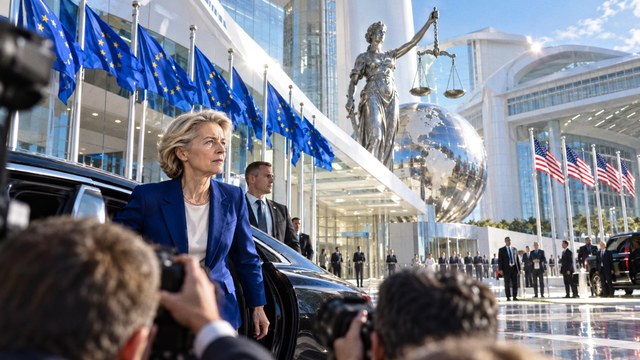
European Union shields war crimes court from Donald Trump sanctions
17 October 2026Leaders of 27 European nations ordered protections for companies supplying the International Criminal Court after Washington penalised the tribunal.31 sources
Settler attacks disrupt the Palestinian olive harvest
Coordinated violence erupted in the occupied West Bank as masked Israeli settlers assaulted Palestinian farmers during the annual autumn olive harvest. Armed groups set fields and groves ablaze across at least eight villages, injuring 14 people according to the Palestinian Red Crescent.
In the village of Abu Falah, roughly 80 settlers attacked harvesters, injuring several residents and assaulting Heidi Levine, a photojournalist on assignment for The Washington Post. The Israeli military condemned attacks on civilians, while EU leaders in Brussels demanded immediate protections for agricultural livelihoods and unhindered humanitarian aid.
The destruction of groves extinguished seasonal income for hundreds of farming families, making localized clashes in the rural West Bank far more volatile.
The full story is being researched
coming soon
New maritime reporting underscores Iran-war shipping danger
The threat environment surrounding Middle Eastern waterways darkened as British maritime monitors released data charting record-high aggression near the Strait of Hormuz. A BBC Verify review showed 12 commercial ships reported attacks in the waters off Iran between 5 and 11 October, the highest weekly total recorded in that dataset since regional fighting escalated.
Concurrently, the United Kingdom Maritime Trade Operations agency logged 10 hostile incidents for the week ending Friday, cautioning that many harassment episodes go entirely unreported. EU leaders condemned the maritime threats and reiterated demands that Tehran submit to full International Atomic Energy Agency inspections.
What was previously seen as isolated harassment hardened into a documented blockade risk, making elevated marine insurance premiums and rerouted oil cargoes unavoidable for global carriers.
Missiles threaten Aden airport and Saudi oil-export corridor
Regional combat reached closer to critical infrastructure when two missiles slammed into the grounds of Yemen's Aden International Airport as a commercial flight prepared for takeoff. Local security forces attributed the strike to the Houthi movement, which issued no immediate statement, though no civilian casualties were reported.
Hours later, the Saudi-led coalition intercepted a ballistic missile directed at Yanbu, alongside drones and cruise missiles intercepted elsewhere across the kingdom. Yanbu serves as Saudi Arabia's primary strategic energy terminal on the Red Sea, carrying crude pumped overland to bypass the congested Strait of Hormuz.
By directly threatening the kingdom's primary bypass route, the strikes made the entire Arabian energy export grid vulnerable to sudden disruption, erasing the safety margin for global oil flows.
Qatar offers Lebanon electricity and reconstruction support
Seeking to counter state collapse in Beirut, Qatar pledged financial and technical assistance to restore Lebanon's paralyzed electricity grid and rebuild war-ravaged southern communities. The announcement followed official meetings between Qatar's prime minister and Lebanese authorities.
Under the plan, state-owned QatarEnergy and France's TotalEnergies agreed to develop utility-scale solar generation, while Doha committed fresh funding to maintain the Lebanese Armed Forces. The initiatives require formal sign-off from the Lebanese cabinet before financing can be disbursed.
The diplomatic move made state-led reconstruction financially viable for the first time in months, offering a rare alternative to militia-dominated utility services.
Trump waives pending Russia tariffs and sanctions
In a sharp policy pivot, the White House issued an executive order waiving major penalties established under the Lindsey O. Graham Sanctioning Russia and Iran Act just before they were scheduled to take effect. The statute, signed in September, mandated stiff tariffs on Russian commodities and retaliatory measures against international purchasers of Russian oil and gas.
The waiver did not dismantle existing U.S. sanctions, but it stopped the planned escalation from choking off supply and driving up domestic consumer fuel prices. The decision nonetheless uncoupled U.S. policy from congressional mandates and undercut coordinated European attempts to squeeze Moscow's export revenue.
The sudden White House waiver made it impossible for Western allies to present a united economic front, easing immediate revenue pressure on the Kremlin just as fighting intensified.
Threats converge on Black Sea and Gulf shipping
Commercial maritime transit suffered parallel crises across Eastern Europe and the Middle East, stranding crews and inflating shipping costs. Off the Romanian coast, maritime rescue teams resumed the search for seven crew members missing after a drone strike crippled the commercial tanker Wine Trader earlier in the month.
The ongoing salvage operation underscored the physical dangers facing merchant crews in the western Black Sea, where Bulgaria will formally apply for allied anti-drone protection to secure grain corridors. Combined with record-high attack rates reported near Hormuz, commercial operators faced soaring war-risk insurance premiums across two continents.
The documented perils across both waterways made commercial passage substantially more expensive, threatening grain shipments and maritime crude supplies alike.
Brussels prepares safeguards beyond Chinese hybrid cars
European Commission President Ursula von der Leyen warned that Brussels will introduce new import safeguards targeting Chinese industrial products, extending trade restrictions far beyond existing measures on hybrid automobiles. Addressing leaders in Brussels, von der Leyen pointed to a bilateral trade deficit in goods exceeding €1 billion per day.
The initiative aligned with French and German demands to shield domestic manufacturing from subsidized Chinese competition, while British officials weighed whether to match European vehicle duties. While the announcement signaled a protectionist shift, no new tariffs were enacted during the summit.
The Commission's pledge made an expanded trade conflict between Brussels and Beijing almost inevitable, leaving European manufacturers anticipating higher reciprocal barriers.
European Union plans broader curbs on Chinese imports
17 October 2026Brussels prepares sweeping safeguards across heavy manufacturing as a daily trade deficit running above 1 billion euros exposes limits of car quotas.3 sources
Military pressure on energy corridors meets divided economic diplomacy
The global security landscape fractured further as physical attacks on primary maritime corridors intersected with an abrupt divergence in Western economic policy. Missiles and drones imperiled Red Sea and Black Sea trade, Ukrainian power plants burned under heavy Russian bombardment, and oil markets braced for widening disruptions.
Yet instead of tightening collective economic enforcement, Washington paused pending sanctions on Russian energy buyers just as European leaders pledged to pursue them. The result left allied capitals pulling in opposite directions while oil markets absorbed mounting risks across the Persian Gulf and Eastern Europe.
Where things stand
As of 04:30 UTC on 17 October, the global security baseline remains under acute stress, driven by simultaneous military pressures on oil routes and contradictory economic choices among the world's leading capitals. With Brent crude pinned near $110, energy corridors in the Red Sea, the Persian Gulf, and the Black Sea face an unbroken chain of physical disruption.
Yet the central strategic question remains unresolved: whether Western alliances can sustain collective economic deterrence when their domestic priorities diverge. Washington's sudden waiver of Russian energy penalties demonstrated that congressionally mandated sanctions can be dismantled overnight to shield markets, even as allied infrastructure burns.
Crucial decisions loom in the days ahead. NATO's military council must decide whether to deploy combat aircraft and missile batteries to Bulgaria. Middle Eastern investigators have yet to establish official attribution for the Yanbu missile attack, and the European Commission must still publish legal language for its China trade barriers and international court protections. None of these flashpoints produced a peace accord, an active alliance deployment, or a finalized trade tariff within the 24-hour window, leaving the world's major economic powers bracing for the next strike.
Who's involved
United States
Global military and economic power balancing regional defense commitments with domestic energy prices
goal → Shield energy supplies from sudden price shocks while preserving foreign policy discretion on Russia
Donald Trump
President of the United States
goal → Defend a flexible posture toward Moscow by waiving congressionally mandated sanctions and import tariffs
Russia
Combatant state conducting the invasion of Ukraine
goal → Entrench military gains and carve out an unbargainable border buffer inside Ukrainian territory
Vladimir Putin
President of Russia
goal → Establish an expanded security boundary by force while shutting down any future negotiation over the occupied strip
Ukraine
Nation defending its territory and civilian power grid against Russian air assaults
goal → Shield energy utilities from winter destruction while securing long-term European financial and military packages
Volodymyr Zelenskyy
President of Ukraine
goal → Lock in billions in European budget pledges while lobbying allies against easing economic restrictions on Moscow
European Union
Twenty-seven-nation bloc coordinating economic sanctions, defense financing, and industrial policy
goal → Maintain a unified front behind Ukraine, safeguard global legal institutions, and protect domestic industry from subsidized imports
China
Dominant export power and strategic competitor in advanced technology
goal → Establish export limits over high-level computing and intelligence tools while opposing foreign trade barriers
Saudi-led coalition
Regional military alliance safeguarding Arabian Peninsula airspace and energy infrastructure
goal → Defend Red Sea maritime passages and intercept missile strikes aimed at vital domestic oil terminals
Iran
Middle Eastern military power expanding regional influence through allied militias
goal → Preserve strategic leverage across crucial waterways while denying direct responsibility for missile and drone strikes
Bulgaria
Black Sea NATO member state facing spillover hazards from aerial warfare
goal → Secure alliance combat aircraft and specialized air defenses to protect territorial waters and coastal shipping
NATO
Transatlantic military alliance balancing collective defense obligations with escalation control
goal → Assess forward-defense requests along the Black Sea without stumbling into direct clashes with Russian forces