We analyzed this claim: is it true that
Henri B. Kagan and Kenso Soai won the 2026 Nobel Prize in Chemistry for breakthroughs in asymmetric organic synthesis and mirror-image molecules?
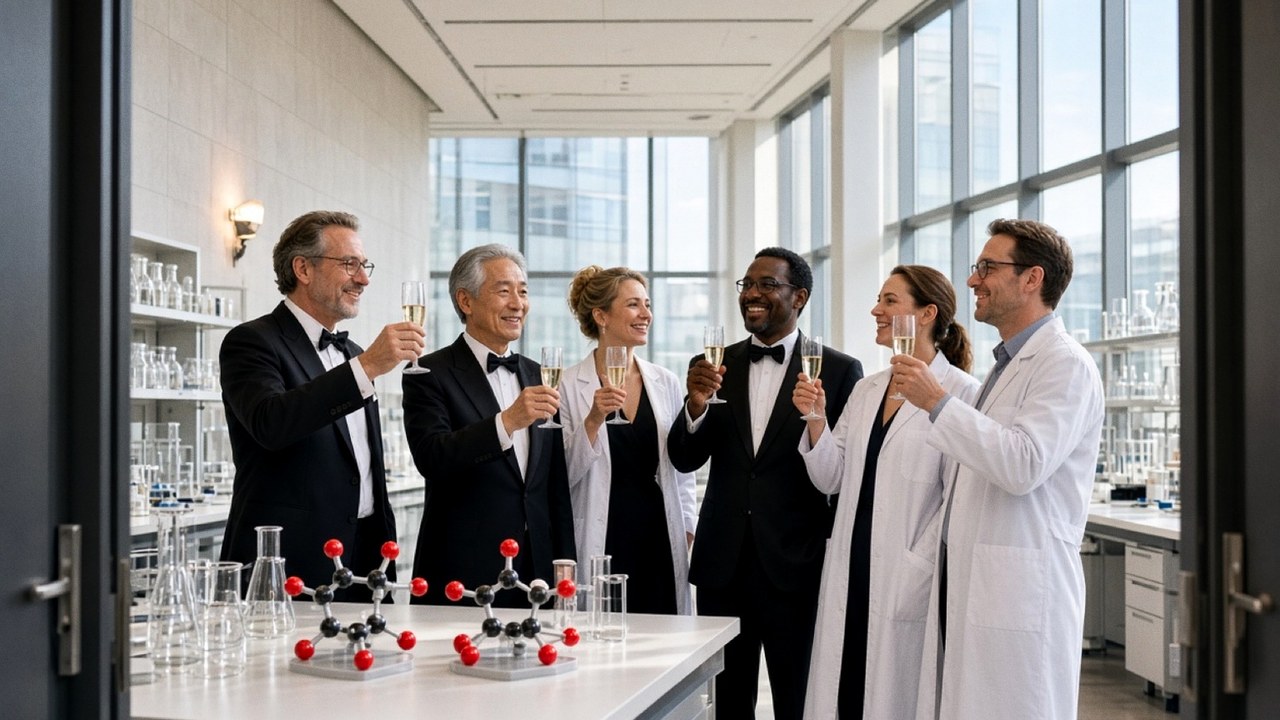
The Royal Swedish Academy of Sciences awarded the 2026 Nobel Prize in Chemistry to Henri B. Kagan and Kenso Soai for discovering non-linear effects and autocatalysis in asymmetric organic synthesis
Henri B. Kagan and Kenso Soai share chemistry Nobel
The Swedish academy honours two chemists who showed how life's mirror-image molecules tip decisively to one side
In a nutshell
Henri B. Kagan and Kenso Soai won the 2026 Nobel Prize in Chemistry for discovering how chemical reactions can take an imperceptible bias between mirror-image molecules and amplify it into overwhelming dominance. Many vital compounds exist in twin left- and right-handed shapes that behave differently in living tissue, yet biology almost exclusively uses one hand. Kagan showed in 1986 that reactions do not have to produce proportional mixtures, and Soai proved in 1995 that a molecule can act as its own helper to create identical copies while suppressing its twin. Their work provided an answer to how life's one-handed chemistry could arise from balanced beginnings, while giving pharmaceutical makers practical tools to isolate pure, single-handed compounds for modern medicine.
Highlights
- Henri B. Kagan and Kenso Soai share the 2026 Nobel Prize in Chemistry and an award of 12 million Swedish kronor.
- Kagan proved in 1986 that asymmetric chemical reactions can amplify molecular handedness non-linearly.
- Soai showed in 1995 that a reaction product can act as an autocatalyst to generate more of its own mirror shape.
- A 2003 experiment demonstrated that a tiny starting imbalance of 0.00005% multiplied to over 99.5% purity after three cycles.
From the Editor’s Diary
A microscopic difference in initial conditions can compound through self-reinforcing feedback until it completely reshapes the physical outcome.
Who's involved
Henri B. Kagan
French chemist and professor emeritus at Université Paris-Sud who revealed non-linear amplification in mirror-image reactions
goal → demonstrate that minor initial imbalances in molecular handedness can produce disproportionately large results
Kenso Soai
Japanese chemist and professor emeritus at Tokyo University of Science who pioneered self-copying asymmetric reactions
goal → show that a reaction product can act as its own catalyst to turn an imperceptible bias into absolute dominance
Royal Swedish Academy of Sciences
Stockholm-based institution that chooses the Nobel laureates in chemistry and physics
goal → establish the formal scientific citation and confer the annual award
Nobel Committee for Chemistry
working body of specialists that reviews nominees for the Royal Swedish Academy
goal → explain the practical value and experimental evidence behind the winning discoveries
Tokyo University of Science
Japanese research institution where Soai conducted his prize-winning experiments
goal → confirm the award and celebrate its faculty member's lifetime achievement
In short
Controlling the left- or right-handed shape of molecules is vital for medicine, because opposite mirror forms of the same chemical often behave differently in human bodies. The Royal Swedish Academy of Sciences awarded the 2026 Nobel Prize in Chemistry to Henri B. Kagan and Kenso Soai for showing how chemical reactions can take a tiny nudge toward one mirror shape and multiply it into complete dominance. This recognition makes broader industrial adoption of self-reinforcing reactions in drug manufacturing likely to follow. That outcome is likely because pharmaceutical makers already rely heavily on one-handed molecules to produce safer treatments, though scaling specific autocatalytic systems to wide factory production remains an ongoing engineering step.
At a press conference in Stockholm on October 7, the Academy announced that Kagan, a French chemist, and Soai, a Japanese chemist, will share the 12 million Swedish kronor prize equally. Their official citation recognizes their discovery of non-linear effects and autocatalysis in asymmetric organic synthesis, resolving a long-standing question about how chemistry can tilt completely toward a single molecular hand.
How it unfolded
Kagan discovers non-linear amplification
Many chemical molecules exist in twin forms that mirror each other like left and right hands, a property called chirality. In 1986, Henri B. Kagan and five colleagues published research showing that a catalyst with a modest preference for one hand did not simply produce a modest excess in the product. Instead, the chemical reaction could behave non-linearly, magnifying a slight tilt into a much larger imbalance.
Soai creates self-reinforcing reactions
Nearly a decade later, Kenso Soai and his team introduced a mechanism that took Kagan's magnification further. In 1995, they demonstrated asymmetric autocatalysis, where a newly formed one-handed molecule serves as a helper to produce more copies of itself. By actively favoring its own mirror shape while suppressing the opposite one, the reaction naturally widened any starting gap.
A trace imbalance takes total control
Soai's laboratory subsequently showed how powerful this self-copying effect could be in practice. In 2003, his team demonstrated that starting with an imbalance as small as roughly 0.00005% between the two mirror forms produced a final output of more than 99.5% of a single form after three rounds. In 2004, chemical engineer Donna Blackmond examined the reaction mechanics, linking Soai's results to Kagan's earlier models and offering a clear chemical explanation for how living nature could have ended up using only one molecular hand.
Stockholm awards the 2026 prize
The Royal Swedish Academy of Sciences announced the 2026 chemistry prize in Stockholm on October 7, awarding it jointly to Kagan and Soai. The Academy highlighted how their laboratory discoveries helped explain both the chemical origins of life and practical methods for manufacturing pure single-handed drugs. The decision confirmed that the two scientists would divide the 12 million Swedish kronor award.
Global confirmation and congratulations follow
Independent scientific journals, academic bodies, and global news agencies confirmed the details of the award within hours of the announcement. Soai spoke to reporters by telephone from Tokyo, explaining that he was out shopping when the Nobel committee called, and later held a university press conference. French President Emmanuel Macron and Japanese Prime Minister Sanae Takaichi issued formal congratulations to both researchers.
Where things stand
The award of the 2026 Nobel Prize in Chemistry to Henri B. Kagan and Kenso Soai is official and settled. The Royal Swedish Academy of Sciences confirmed the decision and its exact citation on October 7, and international scientific organizations verified the findings on the same day. Both laureates will formally receive their medals and share the 12 million Swedish kronor cash prize at the Nobel ceremony in Stockholm on December 10.
Nobel Prizes 2026
Nobel Academy awards $1.2 million for crisis models
12 October 2026Robert Hall and Michael Woodford share the 2026 economics prize for showing how public expectations shape recessions and interest rates.
Navi Pillay wins Nobel Peace Prize
9 October 2026The South African judge won the 2026 peace prize as US sanctions hit the court she once served.
Anne Carson plans to give away $1.2 million Nobel Prize
9 October 2026The Canadian author won the 2026 Nobel Prize in literature and said she wants to pass the award money to others.
Nobel Medicine Prize awards light switches for living brain cells
8 October 2026Sweden's Karolinska Institutet awarded the 12-million-kronor 2026 medicine prize to Karl Deisseroth, Peter Hegemann and Georg Nagel for developing optogenetics, which uses light to control brain cells.
Francis Halzen wins Nobel physics prize
7 October 2026Antarctic ice observatory opens a new view of deep space.