We analyzed this claim: is it true that
Henri Kagan and Kenso Soai demonstrated that chemical reactions can amplify a small imbalance between mirror-image molecules until one molecular form overwhelmingly dominates?
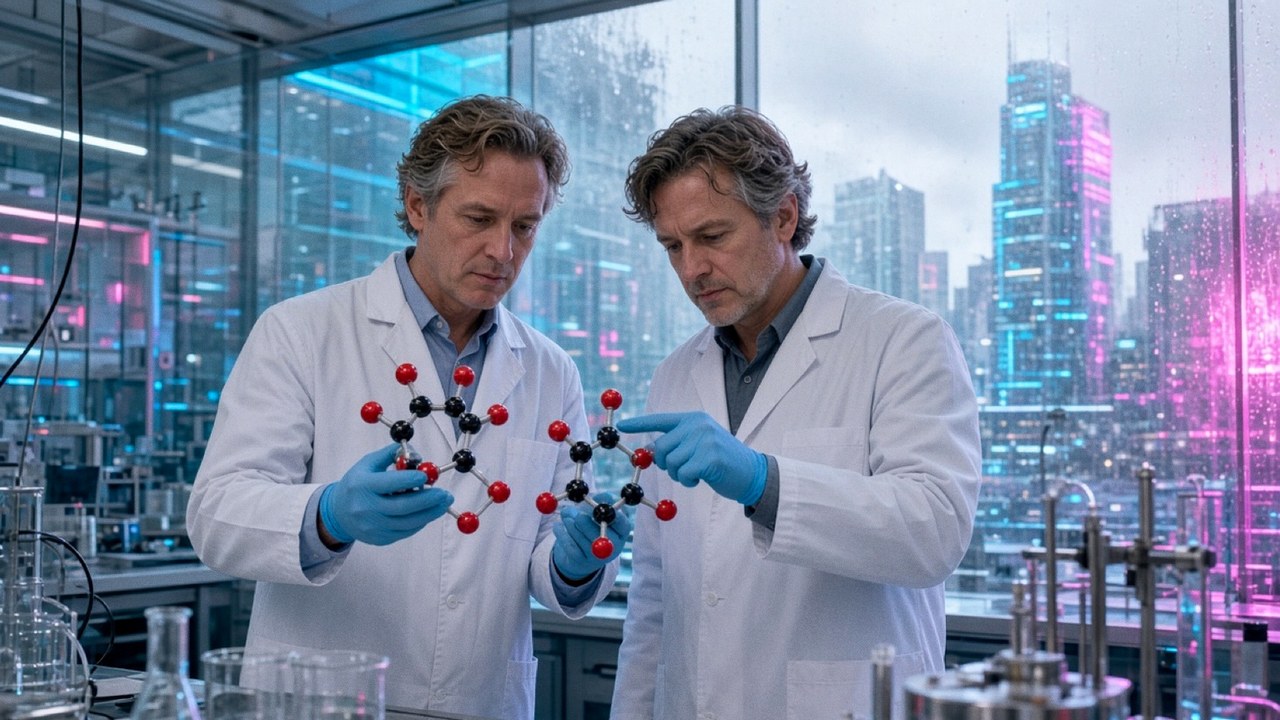
Laboratory experiments established that tiny initial imbalances can multiply until one mirror-image molecule dominates, earning Kagan and Soai the 2026 Nobel Prize in Chemistry, though whether this shaped early life remains unproven
How Molecules Learn to Pick One Hand
Two chemists showed how a tiny chemical nudge can multiply until one mirror-image shape takes over.
In a nutshell
Living organisms build their biology out of molecules that lean strictly to one side, like a world full of left-handed gloves. Henri Kagan and Kenso Soai won the 2026 Nobel Prize in Chemistry for proving that simple chemical systems can take an almost undetectable initial bias and amplify it until one mirror-image shape completely dominates, offering a proven physical model for how life's molecular preference could have started.
Highlights
- Kagan proved in 1986 that reactions do not need pure catalysts to generate heavily one-sided molecular products.
- Soai showed in 1995 that newborn molecules can act as catalysts to duplicate their own handedness.
- Soai's team demonstrated in 2003 that a tiny bias of 0.00005% can multiply into greater than 99.5% purity over three cycles.
- Singleton and Vo observed in 2003 that 54 unbiased reactions split evenly into 27 left-handed and 27 right-handed outcomes.
- Kagan and Soai share the 12-million-kronor 2026 Nobel Prize in Chemistry equally.
Unbiased reaction outcomes in Singleton and Vo tests
| Molecular outcome | Reactions observed |
|---|---|
| Left-handed | 27 |
| Right-handed | 27 |
- Results from 54 identical chemical reactions initiated without any pre-existing molecular bias.
- It demonstrates that random molecular fluctuations alone can determine which mirror shape ultimately takes over.
From the Editor’s Diary
A microscopic tilt can snowball into total dominance if a system feeds on its own success.
Who's involved
Henri B. Kagan
French chemist whose 1986 experiments revealed nonlinear catalysis
goal → Show how imperfect helper molecules can produce highly one-sided chemical reactions
Kenso Soai
Japanese chemist who discovered self-amplifying chemical reactions
goal → Test whether simple chemistry can spontaneously build and preserve molecular handedness
Royal Swedish Academy of Sciences
Independent Swedish institution that selects chemistry Nobel laureates
goal → Recognize fundamental scientific discoveries with enduring significance
Donna G. Blackmond
Chemical researcher who analyzed reaction kinetics
goal → Explain mathematically how molecular systems amplify one hand while suppressing the other
Scott E. Denmark
American organic chemist at the University of Illinois Urbana-Champaign
goal → Map the precise cluster structures that drive self-amplifying reactions
Louis Pasteur
French chemist who first isolated mirror-image chemical crystals in 1848
goal → Understand how crystal shapes alter the path of light
Frederick Charles Frank
British physicist who proposed a mathematical model of molecular competition in 1953
goal → Map the theoretical rules that allow one molecular hand to outcompete its twin
In short
Chemical reactions can naturally amplify an almost invisible imbalance between mirror-image molecules until a single form takes over completely. This shows that the one-handed molecular architecture found in all living biology can emerge purely from ordinary chemical principles without any living guidance.
These discoveries make it likely that drug manufacturers will design more efficient ways to produce single-handed medicines, while origins-of-life scientists test whether similar self-amplifying processes can function in natural prebiotic environments.
Whether this mechanism actually triggered the origin of life remains uncertain and too early to tell, because researchers have yet to prove that comparable self-copying reactions could survive in the messy, water-rich conditions of the primitive Earth.
How it unfolded
Pasteur discovers molecular mirror twins
In 1848, Louis Pasteur noticed that tartaric acid crystals formed two distinct mirror shapes. When separated, each shape bent polarized light in the opposite direction, while a mixed solution showed no optical effect at all. Pasteur proved that molecules possess physical handedness, leaving science with the puzzle of how nature chose between them.
A mathematical blueprint for a runaway reaction
Living systems consistently select one molecular hand, yet ordinary laboratory reactions produce an even mix of both. In 1953, physicist Frederick Charles Frank offered a mathematical answer: if two mirror molecules replicate themselves while suppressing their opposites, any minor imbalance will swiftly trigger a runaway victory for one side. Frank provided the theory, but left behind no real-world chemical recipe.
Kagan breaks the rule of equal proportions
Chemists long assumed that reaction products strictly reflect the balance of the catalysts that make them. In 1986, Henri Kagan overturned that rule by showing that a catalyst with only a mild preference for one hand could yield products with a much larger bias. In 1995, Kenso Soai introduced self-replication, discovering a reaction where a newborn molecule serves as a catalyst to produce more copies of its own hand.
A billionfold jump to near-total purity
In 2003, Soai's team demonstrated that an almost undetectable bias of 0.00005% could multiply across three reaction cycles into greater than 99.5% excess of a single hand. Later that year, Daniel Singleton and Loan Vo ran 54 reactions without any initial bias, obtaining exactly 27 left-handed and 27 right-handed results. Random chance could decide the winner, proving that biology was not required to produce near-total molecular purity.
Mapping the machinery behind the reaction
Though the reaction worked, its inner mechanics remained elusive. In 2020, Scott Denmark and his collaborators showed that the reaction relies on four-part molecular assemblies called tetramers. These clusters operate efficiently when constructed from molecules of the same hand, but break down when shapes are mixed. The finding offered a structural explanation for why homogeneous assemblies rapidly outpace their rivals.
Stockholm honors the architects of asymmetry
On October 7, 2026, the Royal Swedish Academy of Sciences awarded the Nobel Prize in Chemistry jointly to Henri Kagan and Kenso Soai, dividing the 12-million-kronor prize equally. The Academy recognized how two discoveries separated by decades solved a fundamental chemical riddle. Japanese Prime Minister Sanae Takaichi phoned Soai to offer congratulations, while French institutions celebrated Kagan's foundational role in molecular chemistry.
Universities celebrate while questions linger
Over the following days, research institutions praised both laureates, citing their work as a vital conceptual clue to how life acquired its uniform handedness. The University of Illinois highlighted Denmark's contribution to decoding the reaction pathway, while French and Japanese academic leaders hailed Kagan and Soai. The core challenge remained unaddressed: confirming whether similar chemistry ever existed on Earth before life began.
We checked again
No new developments at this moment.
Checked the Royal Swedish Academy of Sciences' October 7 documentation (https://www.kva.se/en/news/the-nobel-prize-in-chemistry-2026/), independently corroborated by the Royal Society of Chemistry, and Jiji Press interviews and scientific coverage published October 10–12; these confirm Kagan's 1986 breakthrough, Soai's initial 1995 finding and decisive 2003 demonstration, but reveal no new scientific result, reversal or material development after October 9.
Where things stand
Kagan and Soai are confirmed Nobel laureates and will receive their medals in Stockholm on December 10. While their laboratory reactions prove that small physical imbalances can snowball into overwhelming dominance, their experiments relied on specialized zinc reagents and organic molecules that were not part of early Earth's natural chemistry.
The deeper question of how living biology chose its uniform molecular shapes remains unanswered. Future research will test whether comparable self-amplifying processes can function in natural prebiotic environments, such as water, and connect to ordinary amino acids and genetic sugars.
Sources
- C. Puchot, O. Samuel, E. Dunach, S. Zhao, C. Agami and Henri B. Kagan, Journal of the American Chemical Society
- Denis Guillaneux, Shu-Hai Zhao, Odile Samuel, David Rainford and Henri B. Kagan, Journal of the American Chemical Society
- Daniel A. Singleton and Loan K. Vo, Organic Letters, experimental investigation of the Soai reaction
- Donna G. Blackmond, Proceedings of the National Academy of Sciences, asymmetric autocatalysis and homochirality
- Soumitra V. Athavale and collaborators, ChemRxiv, mechanistic research preprint
- Soumitra V. Athavale, Adam Simon, Kendall N. Houk and Scott E. Denmark, Nature Chemistry, peer-reviewed structural and mechanistic study
- Royal Swedish Academy of Sciences, official 2026 Nobel Prize in Chemistry decision and press release
- Royal Swedish Academy of Sciences, official announcement event schedule
- Nobel Prize Outreach, Kenso Soai's first-reaction telephone interview
- Prime Minister's Office of Japan, official congratulatory telephone call to Kenso Soai
- Prime Minister Sanae Takaichi, official statement on the chemistry Nobel
- Université Paris-Saclay, official institutional announcement recognizing Henri Kagan
- French Academy of Sciences, official congratulations to Henri Kagan and Kenso Soai
- Tokyo University of Science, official announcement and account of Soai's October 7 press conference
- University of Tokyo, President Teruo Fujii's message congratulating alumnus Kenso Soai
- Collège de France, institutional tribute to Henri Kagan and his early scientific career
- Reuters, Marie Mannes, Simon Johnson and Johan Ahlander, chemistry Nobel announcement and laureate reactions
- Associated Press, independent reporting on the chemistry Nobel and molecular asymmetry
- Chemistry World, Mason Wakley, explanation of the prize-winning reactions and their historical significance
- The Guardian, Linda Geddes, chemistry Nobel and the pharmaceutical importance of mirror-image molecules
- Nature, Elizabeth Gibney and collaborators, reporting on the discovery, prize decision and remaining origin-of-life questions; updated October 8