Tesla missed adjusted-profit and automotive-margin forecasts despite record deliveries; filings identify weaker pricing, lower regulatory credits, energy-margin pressure and sharply higher AI-related spending, although whether the squeeze is structural remains unresolved.
Tesla’s Record Deliveries Collide With the Cost of Its AI Bet
Tesla delivered more vehicles than ever in a second quarter, but falling margins and a $5.79 billion investment surge left profit far below Wall Street’s forecast.
The story continues
Tesla’s 10 Million Cars Test Its AI Spending
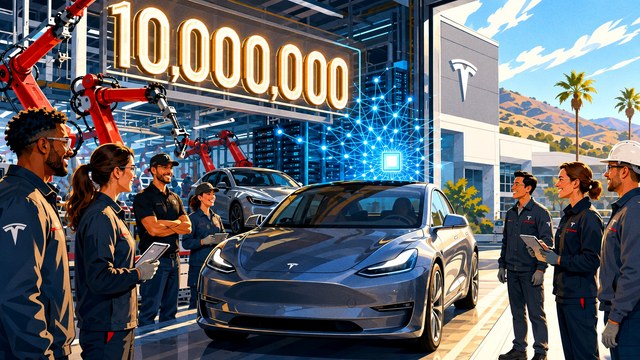
2 August 2026Tesla says its 10 millionth vehicle was produced at its Fremont factory in California during the week of July 27, 2026, as weaker car profits strain its costly push into artificial intelligence.
Who's involved
Tesla
An Austin, Texas-based company that sells electric vehicles, batteries, charging services and software designed to help cars drive themselves
goal → Defend demand for its vehicles while paying for an expensive expansion into artificial intelligence, robotaxis, robots and semiconductors
Elon Musk
Tesla’s chief executive and the leading public advocate for its self-driving and robotics strategy
goal → Persuade investors that today’s heavy spending and weaker margins can produce much larger returns in the future
Vaibhav Taneja
Tesla’s chief financial officer, responsible for explaining how the company will fund its strategy and protect its finances
goal → Maintain enough liquidity to support more than $25 billion of planned 2026 capital expenditure
Tesla automotive operations
The factories, sales network and software businesses that generate most of Tesla’s revenue
goal → Increase deliveries, prices, software subscriptions and factory efficiency enough to finance Tesla’s newer businesses
Tesla Energy
Tesla’s business for Megapack grid batteries, Powerwall home batteries, solar products and energy storage
goal → Turn growing demand for storage into reliable profit without further pricing pressure or warranty costs
Wall Street analysts and investors
The institutions and shareholders whose forecasts and trading decisions help determine Tesla’s market value
goal → Decide whether record vehicle sales support Tesla’s valuation while margins and free cash flow are weakening
In short
TL;DR: Tesla’s record second-quarter deliveries lifted revenue to $28.24 billion, but adjusted earnings reached only $0.33 a share against the $0.51 average estimate cited by Reuters. Heavy spending on artificial intelligence, robotaxis and robots pushed free cash flow to negative $1.09 billion.
The quarter exposed the widening gap between Tesla’s car business and the future Chief Executive Elon Musk is asking it to finance. Deliveries rose 25% year over year to 480,126, yet average revenue per vehicle fell, regulatory-credit revenue dropped 67%, and automotive gross margin excluding credits declined from 19.2% in the first quarter to 16.3%, below analysts’ expectations. Operating income fell 57% to $398 million, leaving an operating margin of 1.4%, the share of revenue remaining after operating costs.
Tesla Energy, which sells grid batteries, home batteries and solar products, increased revenue and storage deployments, but its gross margin fell from 30.3% to 20.4% after lower Megapack prices, weaker Powerwall volumes and warranty charges. Services provided the strongest counterweight, delivering record gross profit.
How it unfolded
Tesla sets the bar before the quarter closes
Before investors could judge Tesla’s second quarter, the company told them what its analysts expected. A company-compiled consensus from 22 sell-side analysts projected 406,024 vehicle deliveries and 13.8 GWh of energy-storage deployments, with GWh measuring the amount of electricity the batteries could store. Tesla, not the X accounts that later amplified the figures, was the first primary source in the chronology. Deliveries would clear that benchmark by a wide margin, lifting expectations before the financial cost of the recovery became visible.
Record volume raises the price of proving the recovery
Tesla’s July delivery announcement appeared to deliver the breakthrough investors had been waiting for. The company handed over 480,126 vehicles, roughly 74,000 more than its own compiled consensus, while producing 451,758 and deploying 13.5 GWh of energy storage. Deliveries exceeded production by more than 28,000, helping reduce unsold inventory. Yet Tesla added a warning that would soon matter: delivery volume was only one measure of performance and should not be treated as a guide to earnings, because prices, costs and currency movements would shape the financial result. By July 21, Reuters reported that analysts were preparing for Tesla’s first quarter of negative free cash flow—the cash left after capital spending—in more than two years as investment in AI and robotics accelerated.
The revenue surprise gives way to the profit miss
When the complete results arrived after the U.S. market closed, the headline split in two. Revenue was stronger than expected. Profit was not. Tesla reported $28.236 billion of revenue, $1.153 billion of adjusted net income and adjusted earnings of $0.33 a share. Reuters cited an average revenue forecast of $25.71 billion and an adjusted-profit forecast of $0.51 a share. The company generated $4.697 billion in cash from operations, but $5.789 billion of capital expenditure pulled free cash flow to negative $1.092 billion. Even the publication sequence resisted a simple narrative: Reuters’s report carried a 20:09 UTC timestamp, while Nasdaq marked Tesla’s Business Wire advisory at 16:14 EDT, five minutes later in absolute time. The verified primary source remained Tesla’s investor update, followed by its filings with the SEC, the U.S. securities regulator.
Tesla sells more cars but earns less from each dollar
The central contradiction was inside the business that still pays most of Tesla’s bills. Automotive revenue rose 23% year over year to $20.516 billion as deliveries climbed 25%, but lower average selling prices and the mix of vehicles sold reduced profitability. Reuters calculated that average revenue per delivered vehicle fell to about $42,730 from $45,345. Regulatory credits, which Tesla earns by exceeding emissions rules and can sell to other automakers, contributed only $146 million, down from $439 million. Because those credits have historically carried high margins, the decline mattered. Total automotive gross margin slipped to 16.9%, while the margin excluding credits fell from 19.2% in the first quarter to 16.3%. Visible Alpha’s analyst consensus had been 18.04%. Tesla had found more buyers. It had not converted them into the profit investors expected.
Energy loses margin as services absorb part of the shock
Beyond cars, Tesla’s established businesses pulled in opposite directions. Energy-generation and storage revenue rose 13% to $3.139 billion, while deployments increased 41% to 13.5 GWh. But the extra volume did not protect profit: the segment’s gross profit fell from $846 million to $640 million, and its gross margin dropped ten percentage points to 20.4%. Tesla pointed to lower average prices for Megapack, its large grid battery; fewer deployments of Powerwall, its home battery; an unfavorable sales mix; and warranty adjustments, including charges tied to a vendor cell issue. Services moved the other way. Revenue from services and other activities rose 50% to $4.581 billion, producing record gross profit of $648 million and cushioning part of the weakness in vehicles and energy.
Musk’s AI strategy moves from promise to expense
The cost of Tesla’s proposed transformation was no longer confined to presentations about the future. It was now running through the income statement. Research and development expense rose 49% to $2.371 billion, mainly because of AI and other programmes. Selling, general and administrative expense—the cost of running the wider company—increased 45% to $1.982 billion. Together, total operating expenses climbed 47%, helping drive operating income down from $923 million to $398 million. Capital expenditure rose from $2.394 billion a year earlier and $2.493 billion in the first quarter to $5.789 billion. Tesla said it had more than doubled its onsite computing capacity in Texas during the first half while continuing to build Cortex AI-computing clusters, Cybercab production facilities, Optimus robot lines, battery capacity, semiconductor manufacturing and solar facilities. A $1.005 billion unrealized gain on Tesla’s SpaceX investment also supported net income under standard accounting rules, making the decline in the underlying operations less obvious in the headline profit figure.
Investors stop pricing the promise and ask for proof
The first after-hours decline became a far stronger rejection once regular trading opened. Tesla shares closed approximately 14.5% lower at about $319 on July 23, their sharpest fall in roughly a year and their lowest level in 11 months. The broader market was also under pressure from Alphabet’s spending plans and a surge in oil prices, but Tesla brought its own list of concerns: adjusted profit had missed forecasts, automotive margin had fallen short, and management remained committed to high capital spending. Reuters described the result as a test of whether Tesla’s car and energy operations can generate enough cash to finance autonomous vehicles and robotics before those projects begin producing meaningful revenue. That is now the argument at the center of the company’s valuation. The future may be large. The bill has already arrived.
Where things stand
Tesla’s quarter was mixed, not uniformly weak. Demand improved. Deliveries reached a second-quarter record, and inventory days—the average time vehicles remained unsold—fell sequentially from 27 to 15. Energy deployments recovered. Active subscriptions to Full Self-Driving, Tesla’s paid driver-assistance software, rose 56% year over year to 1.48 million. Operating cash flow increased 85% to $4.697 billion. Services became a more important source of profit.
The problem is conversion. Tesla produced less automotive margin than analysts expected. Energy-storage profitability weakened. Operating expenses rose much faster than revenue, and capital expenditure exceeded the cash generated by operations. It remains unclear whether lower vehicle prices and energy warranty costs are temporary, whether regulatory-credit revenue will keep shrinking, and when robotaxis, Full Self-Driving, Cybercab and Optimus can generate enough high-margin revenue to justify investment exceeding $25 billion this year. The next decisive evidence will come from third-quarter vehicle prices and margins, energy warranty costs, capital expenditure, free cash flow, Full Self-Driving subscription growth and the number of commercial robotaxi rides that operate genuinely without human supervision.