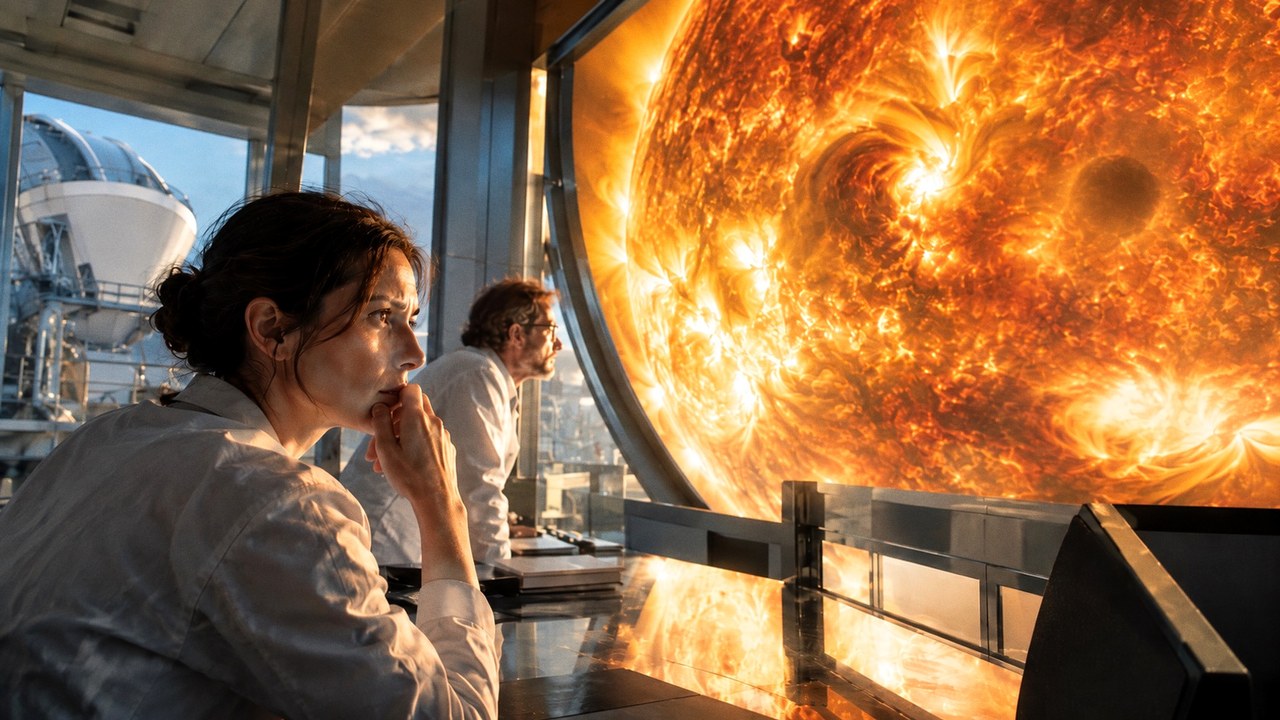
A peer-reviewed solar-evolution model fits several observations better after adding the equivalent of roughly 5–10 Earth masses of metal-rich planetary material, but no planet, remnant or unique engulfment fingerprint has been directly detected; the actual swallowing event remains (unconfirmed).
Mutlu Yildiz models Sun eating 5.6 Earths
A Turkish astronomer finds that swallowing an early rocky planet solves long-standing puzzles about the Sun's interior, though physical proof remains unconfirmed.
In a nutshell
Computer models of our Sun have never quite agreed with real measurements of its interior sound speeds and chemistry. A new study by Turkish astronomer Mutlu Yildiz suggests the puzzle vanishes if the young Sun swallowed a rocky planet between 5 and 10 times the mass of Earth. While the idea neatly explains why our Solar System lacks the close-in planets common around other stars, it remains an unconfirmed mathematical match until solar telescopes independently detect the chemical scar buried deep inside the Sun.
Highlights
- Standard computer models of the Sun fail to match measured internal sound speeds and chemical distributions.
- A model where the young Sun absorbs a rocky body of about 5.6 Earth masses reproduces the real Sun's internal features far more accurately.
- Related successful simulations calculate the ingested rocky material at roughly 5 to 10 Earth masses.
- The study does not prove a planet was swallowed, and direct physical detection of the buried material is still required.
From the Editor’s Diary
Theoretical calculations can solve long-standing cosmic mysteries on paper, but an elegant computer model is not historical fact until real-world instruments detect the physical evidence left behind.
Who's involved
Mutlu Yıldız
an astronomer at Ege University in Izmir, Turkey, and author of the new research paper
goal → test whether the Sun swallowing an early planet resolves known solar-model discrepancies and predict a detectable fingerprint
Royal Astronomical Society
the British astronomical organisation that published the study in its monthly scientific journal
goal → share the peer-reviewed research while reminding the public that independent observational proof is still required
Rebecca G. Martin and Mario Livio
astrophysicists who showed in 2016 that planets can spiral into young stars
goal → explain why our Solar System has no close-in super-Earths by proposing they fell into the Sun
Konstantin Batygin and Gregory Laughlin
planetary scientists who simulated early planetary destruction in 2015
goal → demonstrate how Jupiter moving inward could have pushed an earlier generation of inner planets directly into the Sun
Alessandro Morbidelli and Sean Raymond
planetary scientists who reviewed early planet-loss theories in 2016
goal → require a viable physical destruction path and direct physical evidence before accepting that early super-Earths existed
In short
A Turkish astronomer has found that our Sun's interior makes far more sense if the young star swallowed a large rocky planet early in its life. Standard computer models of the Sun have long struggled to match how sound waves travel through its deep layers and how chemicals are spread inside it. By simulating an infant Sun that devoured a rocky world about 5.6 times the mass of Earth, the new model resolves several of these structural mismatches at once.
Astronomers will now test the Sun's deep sound waves for an independent physical trace of this hidden, metal-rich layer.
Whether such an ancient crash actually happened remains uncertain because the finding is a theoretical computer match rather than an observational discovery. Confirming it requires independent solar instruments to physically detect the predicted chemical scar beneath the boiling outer shell of the Sun.
How it unfolded
Theorists find a path into the Sun
The idea that the early Solar System destroyed its first inner worlds began as a way to explain why nothing orbits close to our Sun. In early 2015, researchers showed that if giant Jupiter shifted inward during its youth, it would trigger collisions that swept early inner worlds directly into the Sun.
Planet destruction meets scientific doubt
Researchers soon showed that large rocky planets could easily migrate through gas clouds straight into the newborn Sun. But sceptics pointed out that nobody had proven such planets could survive the rough journey, and demanded real physical evidence inside the Sun before writing it into history books.
Looking for ancient planetary debris inside the Sun
A decade later, Turkish astronomer Mutlu Yildiz tested whether a swallowed planet would leave a permanent mark on the Sun. He built digital models of the Sun's birth that included an early dose of heavy rock, testing whether the simulated star matched real-world measurements of solar sound waves and chemical mixing.
A 5.6-Earth planet produces the cleanest match
The published study showed that adding a rocky world of about 5.6 Earth masses settled the Sun's major internal mismatches better than any standard model. The rocky debris forms a dense layer just beneath the outer boiling zone, smoothing out sound speeds and matching measured surface chemistry, though the crash itself remains unconfirmed by telescopes.
The hypothesis makes global news
Global media quickly covered the finding as a potential lost world hidden inside our star. Reports noted that while the math explains long-standing solar anomalies, astronomers have not actually seen a planet inside the Sun.
Where things stand
As of September 15, 2026, scientists have a computer model that explains several real solar anomalies by assuming the infant Sun absorbed a rocky body of about 5.6 Earth masses, with related solutions ranging from 5 to 10 Earth masses. The model places this event early in the Sun's formation, around 20 to 21 million years in some tests, but no exact date is proven.
What remains unproven is whether this planet ever existed. The buried layer of heavy elements is a calculated mathematical fit, not an observed object. Turning this into settled history will require independent instruments to physically detect the heavy layer inside the Sun and detailed simulations proving that a rocky world could survive the fall to deposit its debris in that exact spot.