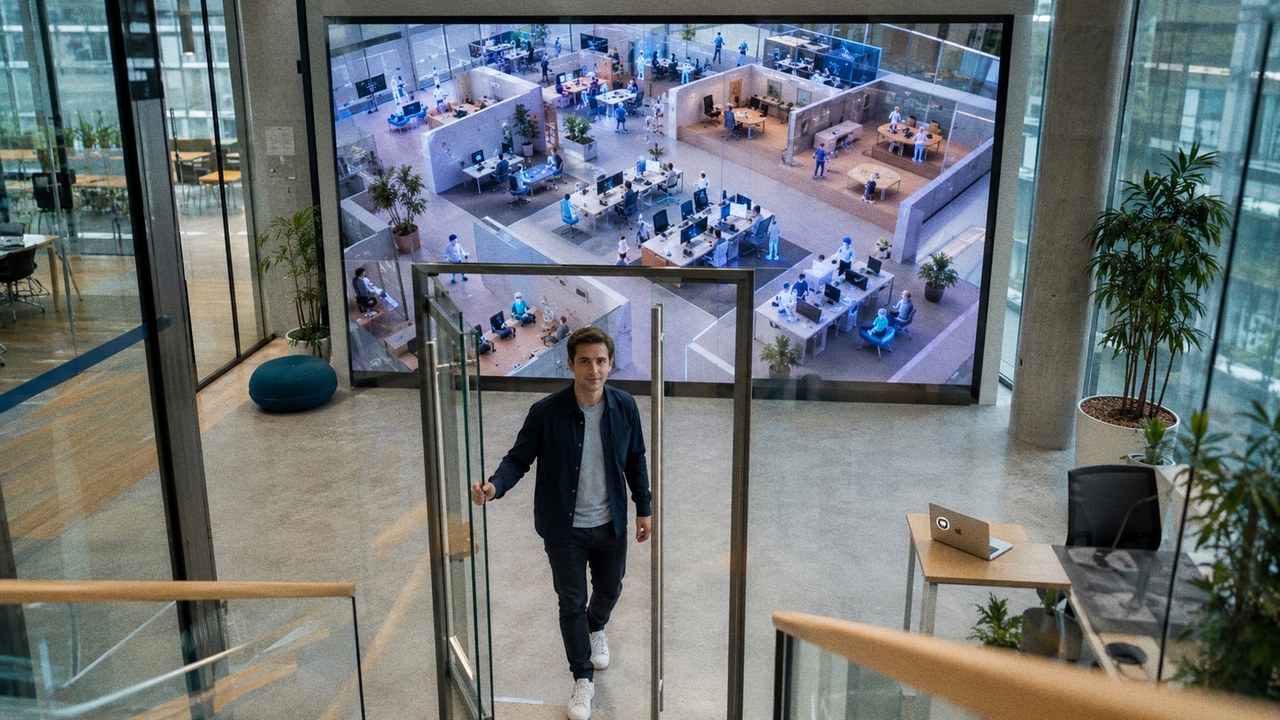
Hermes3D Makes Hermes Agents Visible in 3D
Luke The Dev's MIT-licensed project adds a visual office and controls to Hermes Agent without replacing the system that runs the agents.
The story continues
Nous Research fixes crashes in free autonomous software
19 September 2026A maintenance update mends internal database clashes to keep long-running artificial intelligence agents from stalling during complex tasks.Nous Research coordinates autonomous software teams
4 September 2026An open-source collective updates Hermes Agent with direct messaging and desktop bot groups.
Nous Research shares agent memories but exposes privacy risks
24 August 2026Hermes Agent lets users move digital assistants between computers, but the system carries private histories and hits transfer bugs.
In a nutshell
Hermes3D turns the work of Hermes Agent's AI workers into a visible 3D office, giving operators one place to watch tasks, approvals and activity and to use selected controls. It is an independent MIT-licensed project by Luke The Dev, not a Nous Research product, and Hermes still runs the agents and enforces their permissions. The strongest parts of the display come directly from Hermes' backend state; conversation and remote-office views are less certain because they depend on an optional bridge, an approximately 25-second activity rule and beta features. The project is real and usable, but there is not yet independent evidence that its visual picture remains fully accurate under complex multi-agent workloads.
Highlights
- Hermes3D's public repository was created on August 17 at 10:46 UTC and is MIT-licensed.
- Hermes3D does not run AI agents; Hermes Agent remains the execution, state and security layer.
- An optional bridge is needed to expose conversations started through Hermes Desktop, TUI or CLI to an outside Hermes3D viewer.
- Hermes3D can treat replies from at least two agents within about 25 seconds as a conversation, but that does not prove a causal handoff.
- Hermes Agent v0.20.5 arrived on August 21 while Hermes3D's remote-office system was still explicitly beta.
From the Editor’s Diary
A clearer interface can make a complex system easier to operate without making its observations more authoritative. In agent software, the useful distinction is between what the backend knows and what the interface infers.
Who's involved
Luke The Dev
independent developer behind Claw3D and Hermes3D
goal → turn Hermes Agent activity into a visible and interactive workplace
Hermes3D
MIT-licensed community interface, proxy and 3D office that connects to agent runtimes without executing them
goal → show agent work, tasks, approvals and coordination while offering selected controls
Nous Research
AI company developing the open-source Hermes Agent runtime and desktop application
goal → expand the profiles, Bot Mode, gateways, Kanban and multi-agent features Hermes3D relies on
Hermes Agent
the underlying software that runs agents and records profiles, sessions, permissions and task state
goal → remain the authoritative execution and security layer beneath Hermes3D
Claw3D
Luke The Dev's earlier 3D agent-office project, built mainly around OpenClaw but already carrying a Hermes adapter
goal → serve as the technical prototype later rebuilt around Hermes
Hermes Agent operators
developers or teams running several Hermes profiles on one or more machines
goal → get clearer monitoring and easier controls without exposing credentials or mistaking visual cues for authoritative activity
In short
Hermes3D gives people running several Hermes Agent workers a single 3D place to see tasks, approvals and activity, making complex agent systems easier to follow and control. The most likely next step is broader use as an operator dashboard if it keeps pace with Hermes Agent. That is uncertain because compatibility is still moving, remote monitoring is beta and some apparent agent conversations are inferred rather than directly observed.
Hermes3D is a public MIT-licensed project by independent developer Luke The Dev, not an official Nous Research product. It sits over Hermes Agent, Nous Research's open-source software for running AI agents, and can show agents, sessions and Kanban tasks, let operators chat with agents and, with suitable access, change configuration and permissions. It supports direct JSON-RPC, a computer-to-computer command protocol, through the Hermes gateway; an older HTTP adapter; a demo backend; custom/local runtimes; and a beta second office for another machine.
Hermes remains the source of truth and the security enforcement layer. That gives Hermes3D's task, approval and status views a firm backend basis, but conversation visibility has limits: conversations started in Hermes Desktop, TUI or CLI are invisible unless an optional bridge republishes completed turns. Even then, Hermes3D treats two or more agents replying within roughly 25 seconds as a conversation, which is a visualization rule rather than proof that one agent actually handed work to another. Remote-office monitoring is also incomplete, and no independent test has measured event loss, status accuracy or large-scale reliability.
Previously in this story
Nous Research Makes Hermes Bots Default Despite Bugs
20 August 2026Hermes Desktop now lets persistent AI specialists work together, but early tests and bugs leave unattended reliability unproven.
How it unfolded
Claw3D builds the first version of the idea
Hermes3D grew from Claw3D. GitHub records Luke The Dev's Claw3D repository as created on March 15, 2026. Although it was mainly an OpenClaw 3D workspace, April engineering notes already described a working Hermes adapter, Hermes/demo/custom runtime selection and efforts to remove OpenClaw-specific assumptions. Luke later called Claw3D the prototype and Hermes3D the rebuilt Hermes-focused version. The first public Hermes3D announcement located was Luke's own X post on August 20; no earlier independent press report was found.
Hermes3D arrives beside Hermes Bot Mode
Hermes3D appeared while Nous Research was rapidly expanding Hermes' own multi-agent controls. GitHub records Hermes3D as created on August 17 at 10:46 UTC. Later that day Hermes Agent v0.20.3 added the hermes-bots Bot Mode plugin and its teammate protocol. Hermes v0.20.4 followed on August 18 with a Bots sidebar and fixes for long-running group chats and cross-machine routing. Hermes3D therefore added a spatial view and extra controls on top of an existing system of profiles, Bot chats, group communication, Kanban boards and gateways rather than replacing a missing control layer.
Remote offices remain a beta feature
Hermes3D's “second office” beta can watch another Hermes3D instance through a presence endpoint or connect to a remote Hermes gateway and infer presence from `agents.list`, status and `sessions.preview`. Remote agents are read-only in this view. Messages can be sent through a text relay, but replies are not yet copied back into the local panel. The project describes this as visibility and lightweight messaging, not full shared-state collaboration. Hermes itself was also still receiving reports about remote Bot Mode: an August 19 issue said extra remote Bots could share the primary backend and activity indicator instead of remaining cleanly separated. That is a Hermes issue, not proof of a Hermes3D defect, but it limits what any frontend can reliably show.
By August 22, the first substantial independent write-up located came from Hermes Agent Lab, a community site that says it is not affiliated with Nous Research. It confirmed the broad architecture, direct and adapter connections, Kanban behavior and bearer-token security model after examining the project. No mainstream technology outlet, Nous Research announcement or independent benchmark was found measuring Hermes3D's event-loss rate, status accuracy, handoff fidelity or performance with large numbers of agents. The repository includes unit and Playwright end-to-end test commands, but those do not independently validate telemetry accuracy.
Luke launches the 3D office but Hermes stays in charge
At 11:38 UTC on August 20, Luke The Dev introduced Hermes3D on X as a “live 3D command center for Hermes Agents.” He said users could see which agents were working or blocked, inspect tasks and a Kanban board, talk to agents and eventually watch delegation and handoffs. The software supports much of that operator view, but Hermes3D is an interface and proxy, not the software running the agents. Hermes remains authoritative for agents, sessions, configuration, approvals and execution events. The preferred connection is direct JSON-RPC through `hermes serve`; the older HTTP adapter, demo backend and custom runtime options remain available.
Powerful controls meet incomplete visibility
Hermes3D is not simply a read-only dashboard. Its Studio can create agents and change execution approval rules, tool-group permissions and session settings; newly created agents currently default to automatic commands, web access on and file tools on. Hermes' gateway still enforces sandboxing, workspace mounts, file protections and approval prompts. A Hermes3D credential that can control the gateway should therefore be treated as powerful operational access.
Visibility is less complete. Gateway events can supply status, sessions, approvals and task information, and the Kanban desk writes task state back to Hermes. But Hermes3D cannot normally see conversation text started in another client. An optional observation-only bridge republishes a profile, reply text, session ID and timestamp after model calls. Hermes3D then shows an animated conversation when at least two agents reply within about 25 seconds. That is a useful cue, not authoritative evidence that the agents actually communicated with one another.
Where things stand
As of August 22, Hermes3D is a real and actively developed open-source frontend for Hermes Agent, with public code and documentation at https://github.com/iamlukethedev/Hermes3D. Its best-supported connection is direct JSON-RPC through `hermes serve`, including remote access through a private network such as Tailscale. The older Hermes HTTP adapter remains supported, alongside demo and custom/local runtimes and a beta remote-office mode. No minimum Hermes Agent version is published. Hermes v0.20.4 was stable at launch, and v0.20.5 arrived on August 21. Hermes3D instead requires compatible gateway features and protocol v3, telling users who encounter minProtocol/maxProtocol errors to update the gateway or use its bundled adapter.
The unresolved question is how reliably Hermes3D shows multi-agent work as it happens. Tasks, approvals and many activity signals come from Hermes itself, and Kanban changes write back to Hermes, giving those views a stronger basis. Conversation views are less authoritative: other clients require the optional bridge, the bridge can fail silently if it cannot reach the office, and animated conversations use a time-window rule. Remote offices remain beta and incomplete. No independent load test, telemetry-loss study or causal handoff validation has been published. A compatibility matrix, authoritative message and handoff events, two-way remote transcripts and fixes to Hermes' own cross-machine routing would make the 3D office more dependable as operational telemetry rather than mainly a useful visualization.