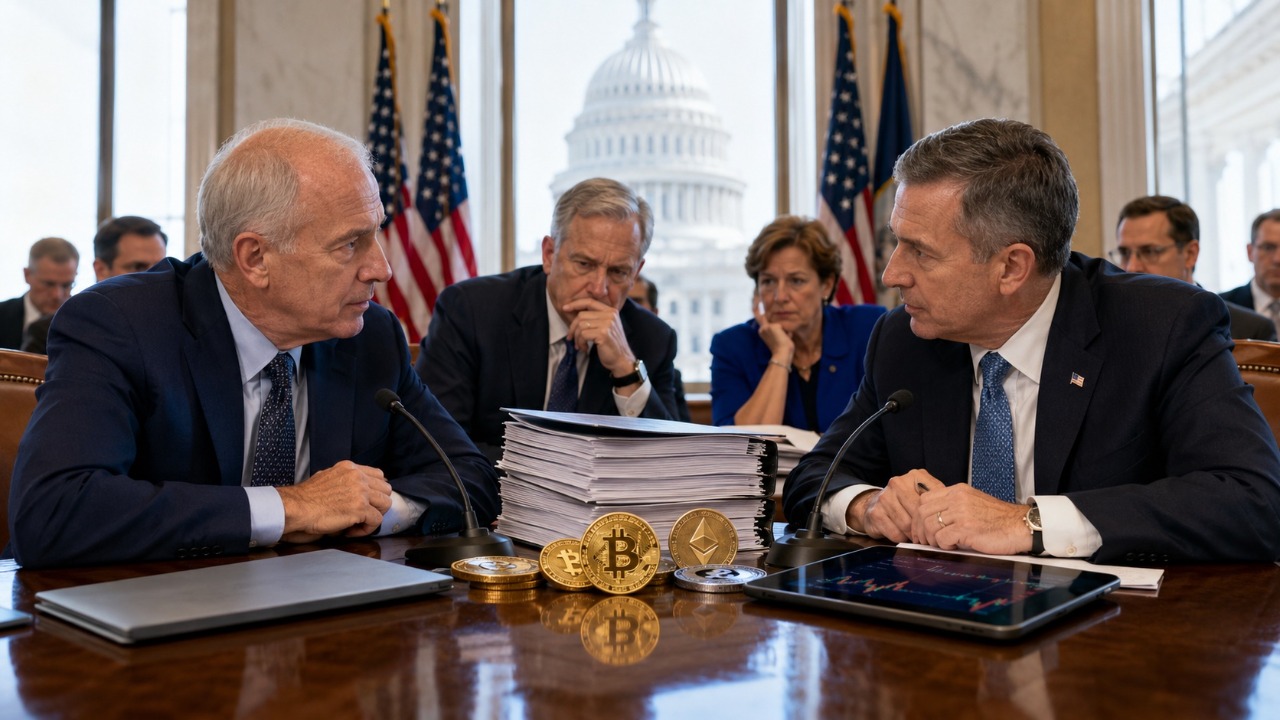
A unified Senate bill now exists, but Democratic resistance, Republican doubts and a crowded calendar have prevented a floor vote from being scheduled.
616-Page Crypto Market Bill Lacks 60 Senate Votes
The Digital Asset Market Clarity Act would set federal cryptocurrency-market rules and divide oversight between the Securities and Exchange Commission, which regulates securities, and the Commodity Futures Trading Commission, which regulates derivatives markets.
Who's involved
Cynthia Lummis
Republican senator from Wyoming and principal Senate author of the combined cryptocurrency-market bill
goal → Secure bipartisan support and move the bill through the Senate before election-year politics reduce the available legislative window
John Thune
Republican Senate majority leader who decides which bills receive debate and voting time
goal → Avoid allocating several days to a bill without 60 votes while managing sanctions, spending and other Senate priorities
Donald Trump and the White House
The president and administration supporting federal rules favourable to cryptocurrency markets
goal → Secure passage while limiting ethics restrictions on the president and other officials to provisions the administration accepts
Senate Democratic negotiators
Angela Alsobrooks, Cory Booker, Catherine Cortez Masto, Ruben Gallego, John Hickenlooper, Mark Warner and Raphael Warnock, who participated in bipartisan negotiations
goal → Strengthen ethics, consumer-protection, illicit-finance and market-integrity rules before providing the votes needed for Senate action
Elizabeth Warren
Massachusetts senator and senior Democrat on the Senate Banking Committee, which oversees financial-market legislation
goal → Defeat or substantially revise a bill she says contains enforcement and investor-protection gaps
Coinbase and the crypto industry
Digital-asset companies seeking permanent federal rules for cryptocurrency markets
goal → Replace regulatory uncertainty with legislation and secure a Senate vote before the August recess
Banking industry
Traditional financial institutions concerned that stablecoins, digital tokens designed to maintain a fixed value, could compete with bank deposits
goal → Prevent stablecoin rewards from operating like deposit interest and shifting funds away from regulated banks
In short
TL;DR: Cynthia Lummis released a 616-page Senate crypto-market bill on July 22, 2026, but seven Democratic negotiators rejected the current text. No vote is scheduled, and completion before the August 7 recess is unlikely without the 60 votes needed to advance it.
The Digital Asset Market Clarity Act would create federal rules for cryptocurrency markets and split supervision between the Securities and Exchange Commission and the Commodity Futures Trading Commission. The House passed an earlier version in July 2025. Senate committees later approved separate sections, which Lummis combined into the July 22 text.
The release did not secure a Senate coalition. Democratic objections cover government ethics, consumer protection, illicit finance, conflicts of interest and market integrity. Disputes also cover stablecoin rewards, software-developer protections and decentralized finance, which uses software rather than traditional financial intermediaries. The earliest binding-vote window is August 3-7 if negotiators secure 60 votes and leadership provides several days of debate; otherwise, the next plausible window begins after September 11.
How it unfolded
Trump accepts Republican cryptocurrency-ethics proposal
Crypto in America reporter Eleanor Terrett and Punchbowl News reporter Brendan Pedersen reported on July 19 that the White House, Lummis and Republican Senator Bernie Moreno had reached an ethics agreement covering Trump. Financial and cryptocurrency media amplified the report on July 21 as a possible legislative breakthrough. The language had not been published, and Senate Democrats had not reviewed it.
Published compromise fails to produce Senate majority
Publication converted the reported agreement into a new negotiating dispute. Lummis released one bill combining the Senate Banking and Agriculture committees’ separate texts, and industry supporters said it was ready for full-Senate debate. The ethics section was narrower than Democrats had requested. It prohibited officials and spouses from issuing or sponsoring digital assets for payment but allowed ordinary cryptocurrency investments, excluded some promotional appearances and gave enforcement authority only to the Justice Department. Seven Democratic negotiators rejected the current text but continued talks. Warren called the draft unacceptable. On July 23, Thune said the Senate probably could not finish the bill before recess. Lummis continued to defend Trump’s concessions, confirming that negotiations remained active, but neither the required votes nor sufficient floor time had emerged.
Where things stand
The combined substitute text remains pending before the full Senate. It has not passed the Senate. Leadership has announced no motion to proceed, cloture vote to end debate or final-passage vote. The bill has not formally collapsed because negotiations remain active. It is not ready for an immediate vote because the published text does not visibly have the bipartisan coalition required to advance.
Three signals determine the next stage: whether Thune starts formal consideration by the end of July; whether Republicans revise Justice Department-only ethics enforcement and the noon January 20, 2029 expiry; and whether the seven Democratic negotiators change their position. A final vote remains possible during August 3-7, but Thune’s July 23 assessment makes completion before recess unlikely. Failure to use that window would shift negotiations to the short Senate session after September 11. Government-funding legislation and the November midterm elections would then reduce the remaining opportunity for passage.