Europe Strained by Energy, War and Coalition Cracks
A 72-hour wave of military strikes, political tremors and fuel worries tests continental resilience.
Later readings
Europe Shaken by Gas Surge, Drone Strike and Crash
29 October 2026A combustible mix of energy spikes, maritime sabotage and political strains tested the continent's stability over 72 hours.Four Days That Shook Europe’s Foundations
26 October 2026Overlapping economic, military and political shocks stretched European resilience to its limits across four volatile days.Europe Strains Under Debt, War and Unrest
22 October 2026Massive German investment pledges soften the blow as French borrowing costs surge and security risks multiply.Europe Governs Under Fire as Crises Converge
19 October 2026Spreading drone scares and budget standoffs test a battered continent fighting to maintain control.
In a nutshell
Sharply tense (−46). Pressure: War on the continent (−84) and Relations with the great powers (−69); support: Enlargement and neighbours (+19).
Highlights
- No gauge moved beyond its usual range.
The score of every gauge
−100 … +100- The needle starts at 0 at the top: right in blue for a plus, left in red for a minus, the ticks counting the way from 0; a dashed scale is quiet.
- Score — −100 maximum stress … +100 calm
Where the activity was
0–100| War on the continent | 100 |
|---|---|
| Central, Eastern and Southeastern Europe | 97 |
| Relations with the great powers | 94 |
| Government and coalition | 91 |
| Debt and budgets | 91 |
| France | 91 |
| Social divides and culture wars | 91 |
| Unity and decisions | 90 |
| Industry and energy | 88 |
| Defence and NATO | 88 |
- How much happened to each gauge in this window, 0–100.
- Activity — 0–100
- Activity is not direction: a busy gauge can be calm, a quiet one tense.
From the Editor’s Diary
The busiest gauge: War on the continent — activity 100 of 100.
In short
A volatile three-day stretch has left Europe absorbing concurrent shocks across its borders, energy markets and political leadership, even as its financial systems and core institutions held their ground. Germany’s ruling coalition was shaken by a high-profile cabinet resignation just as wholesale inflation surged, driving Chancellor Friedrich Merz to pledge household electricity-tax relief against the backdrop of an improved medium-term growth forecast from the International Monetary Fund. Yet high energy prices and weakening domestic demand threaten to derail those gains.
Security risks mounted swiftly to the east. Drone attacks sank a commercial cargo vessel off Bulgaria, leaving 11 sailors missing and prompting Sofia to seek urgent NATO surveillance, while Russian strikes on Ukrainian power facilities cut electricity to roughly 600,000 people. Diplomatic channels proved partially effective nonetheless, with Hungary dropping its objections to advance Ukraine's European Union accession talks.
Across the continent, rising natural gas prices, French budget battles and volatile protests exposed the growing friction between immediate economic survival and long-term policies. European Commission proposals to delay new methane import curbs reflected that trade-off. While equity markets held steady and the European Central Bank saw no entrenched wage-price spiral, deep disagreements over how to finance collective defence and energy resilience loom over forthcoming EU budget talks.
Stories from this reading
Edi Rama rejects calls to resign as student riots spread
16 October 2026Albanian police arrest 16 after education ministry and private banks are set ablaze in tuition protests
How it unfolded
Resilience Tested as Geopolitical and Energy Shocks Converge
Between the morning of October 12 and October 15, European governments faced an abrupt convergence of internal political rifts and external security threats. Germany’s ruling coalition absorbed sudden cabinet turmoil while trying to shield factory floors from a renewed fuel squeeze, just as drone warfare struck commercial shipping near Bulgaria and Russian missiles battered Ukrainian power grids. The test was not whether continental institutions would collapse, but whether state resources could keep pace with an expanding list of domestic and strategic emergencies.
Coalition Resignation Exposes Friction in Berlin
The sudden exit of German Labour Minister Baerbel Bas, who cited the death of her stepdaughter alongside sustained political attacks from conservative coalition partners, exposed raw vulnerabilities inside Chancellor Friedrich Merz’s government. Alexander Schweitzer was quickly tapped to take over the post, and while the shake-up did not threaten to topple the administration, it highlighted fraying trust following regional electoral gains by the far-right Alternative for Germany (AfD).
Merz sought to reclaim momentum by promising across-the-board electricity-tax cuts, but Finance Minister Lars Klingbeil openly questioned whether the state could afford the measure over the long term. That internal strain deepened when AfD and the Sahra Wagenknecht Alliance (BSW) united in the Saxony-Anhalt state legislature to pass a symbolic resolution demanding an end to German arms supplies for Ukraine. The vote carried no power to redirect federal foreign policy, but it breached the traditional cordon sanitaire around the far right, leaving the government in office but visibly defensive.
Gas Deficits Challenge Industrial Competitiveness
The broader European energy framework compounded Germany’s manufacturing headache. A thin reserve cushion heading into winter, caused by lower European gas storage levels and disrupted global shipments of liquefied natural gas (LNG), left heavy chemical and manufacturing plants exposed to volatile fuel costs.
Merz's proposed electricity-tax cut offered temporary margin relief, but it could not expand the physical supply of fuel. The competitive challenge was underscored by Mercedes-Benz Chief Executive Ola Källenius, who warned that proposed EU rules restricting car parts to European manufacturers—excluding suppliers in the United Kingdom—would disrupt automotive assembly lines. The dispute highlighted how trade barriers can hinder industrial recovery when supply chains are already strained by high energy prices.
Merz pledges five billion euro electricity tax cut
14 October 2026German Chancellor Friedrich Merz offered broad power bill relief on Monday, but coalition partners quickly questioned the funding.5 sources
Political Clashes Challenge Mainstream Authority
The acrimony surrounding Bas's exit highlighted the hardening tone within Germany's ruling coalition, while the AfD-BSW alliance in Saxony-Anhalt fused debates over household utility bills with opposition to foreign military aid. The vote turned living costs into an argument against funding external conflicts.
Facing a restive public, Merz told the Bundestag lower house of parliament that competent governance was the only reliable defence against political extremism. The state apparatus continued its work without disruption, but the burden of proof shifted decisively onto mainstream leaders to deliver tangible relief before voter frustration grew further.
Minority Compromise Unlocks Ukraine's EU Talks
A pragmatic legal compromise cleared a major diplomatic obstacle on Ukraine's path toward Europe. Kyiv’s parliament passed legislation on October 12 expanding classroom language rights for Hungarian and other ethnic minorities, prompting Hungarian Prime Minister Péter Magyar to withdraw Budapest’s veto against opening technical negotiating chapters.
The shift enabled negotiations on EU single-market and competitiveness benchmarks to proceed. While wartime conditions and extensive legal reforms mean full membership remains a distant goal, the agreement proved that targeted bilateral negotiations could bypass unilateral national vetoes.
EU unlocks 17 negotiation chapters for Ukraine and Moldova
14 October 2026All 27 member states agreed to open two core economic packages after Kyiv resolved minority rights disputes with Hungary.5 sources
Stock Markets Hold Ground as Chip Demand Offsets Gas Fears
European bourses avoided panic selling, supported by solid corporate earnings and selective tech demand. The DAX index in Frankfurt finished October 14 up 0.15% at 25,298.61 points, while the Euro Stoxx 50 gained 0.33% to 6,187.55, and the broader pan-European STOXX 600 climbed 0.43% to 637.75.
Strength in healthcare shares and an upbeat sales outlook for advanced chipmaking machinery from Dutch supplier ASML offset drops in energy-sensitive industrial sectors, while the euro held at 1.1195 dollars. The resilience across equity markets showed that capital allocation remained orderly, even as investors weighed the broader risks of high fuel costs and government debt.
Surging Factory Costs Threaten German Recovery
Germany's economic troubles sharpened as headline harmonised inflation was confirmed at 3.3% for September, up from 2.9% in August, before factory-gate data revealed much steeper upstream pain. Destatis, the federal statistics office, reported an 8.7% annual jump in wholesale prices driven by expensive industrial inputs and a 48.8% spike in wholesale mineral oil costs.
The economy ministry warned that third-quarter momentum had likely stalled as high utility bills and consumer caution weighed on factory output. While the International Monetary Fund raised its 2026 German growth estimate to 1.3% from 0.7%, that upgrade served only as a medium-term forecast rather than proof that industry had turned the corner. What changed was the policy room available to Berlin, as persistent cost pressures restricted the chancellor's ability to stimulate growth without reigniting inflation.
EU Advances Accession but Hits Budget Impasse
European solidarity offered contradictory signals as foreign policy cohesion contrasted with domestic spending fights. Hungary withdrew its veto on Ukraine's accession talks following Ukrainian legislation protecting minority-language education, clearing negotiations to begin on internal-market and competitiveness rules.
That diplomatic breakthrough stood in sharp contrast to the battle over the EU's 2028-2034 long-term budget. A compromise proposal by Ireland’s presidency trimmed the total package to roughly 1.62 trillion euros, down from the European Commission’s 1.76 trillion euro draft, as net contributors resisted demands for expanded defence, farm and regional aid. The contrast showed that while the bloc could still strike deals on enlargement, funding collective priorities remained stalled.
European Union unlocks two membership tracks for Ukraine
9 October 2026Ambassadors from all 27 nations agree to open market and competitiveness negotiations after Kyiv yields to Budapest on minority education rights.3 sources
Brussels Weighed Climate Deadlines Against Fuel Needs
Faced with tight fuel supplies, the European Commission proposed delaying planned methane-emissions reporting rules for imported fossil fuels by a year, pushing initial compliance from 2027 to 2028. The concession followed appeals from France, the United States and energy suppliers who warned that strict environmental checks risked cutting off fuel deliveries ahead of winter.
Environmental organizations criticized the proposed delay as a retreat on climate commitments, but the move highlighted how supply security took precedence over regulatory enforcement. With ordinary Council legislative votes proceeding without delay on October 13, the policy shift represented a tactical concession to ensure heating supplies rather than an institutional stalemate.
Black Sea Ship Sunk as Russian Strikes Hit Power Grid
The war expanded directly into commercial sea corridors on October 13 when drone strikes hit two merchant vessels off the Bulgarian coast. The Guinea-Bissau-flagged cargo ship HS Dignity sank, leaving 11 sailors missing after five were rescued, while the crew of a second damaged ship was pulled to safety. Bulgaria summoned Moscow’s envoy over suspected Russian involvement, though definitive attribution remained unestablished.
Military strikes hit civilian infrastructure the following day, as Russian missile attacks on Ukraine's power network cut electricity to roughly 600,000 residents. At the same time, judicial proceedings opened in Hamburg against a former Ukrainian officer charged in connection with the 2022 Nord Stream pipeline bombings. The developments showed how the conflict continues to disrupt energy supplies, commercial shipping and legal accountability across Europe.
Drones sink cargo ship off Bulgaria leaving 11 missing
16 October 2026Attacks on two merchant vessels in Bulgarian waters draw NATO into Black Sea crisis6 sources
Bulgaria Demands NATO Cover for Sea Corridors
The sinking off Bulgaria transformed maritime commercial risk into a NATO security emergency. Bulgarian Prime Minister Rumen Radev called on the transatlantic military alliance to deploy additional sea and air surveillance, drawing a pledge from Secretary General Mark Rutte that NATO would adjust its eastern flank posture if needed.
Bulgarian Defence Minister Dimitar Stoyanov said Sofia expected to formally join a regional NATO anti-drone initiative before the end of the month, as Romania and Türkiye coordinated to keep shipping lanes open. At the same time, a fresh military aid pledge from Britain underlined that European defence support remained active despite broader political debates. The incident narrowed the margin of safety for civilian shipping in the Black Sea, making Western naval coordination essential to avoid broader supply disruptions.
Bulgaria seeks NATO shield after sea strikes
16 October 2026Sofia will seek entry to the Western alliance's counter-drone project by October 30 after attacks sank a merchant ship.5 sources
Tech Restrictions Strain Kyiv as Brussels Eyes China
Kyiv's operational difficulties worsened on October 14 as Ukrainian forces reported that satellite restrictions on Starlink and Starshield networks had disrupted frontline drone reconnaissance. SpaceX head Elon Musk said communications speed limits were directed by the US military and the US presidency, leaving operational responsibility disputed amid broader Ukrainian concerns over Donald Trump's stance on Russian oil sanctions.
European officials confirmed that US intelligence-sharing with Ukraine continued uninterrupted. Ahead of the mid-October Brussels summit, France and Germany pressed for collective defensive trade tariffs to protect domestic manufacturers against subsidized Chinese industrial imports. The diplomatic balancing act left Europe trying to counter security pressures from Moscow and Beijing while managing policy friction with Washington.
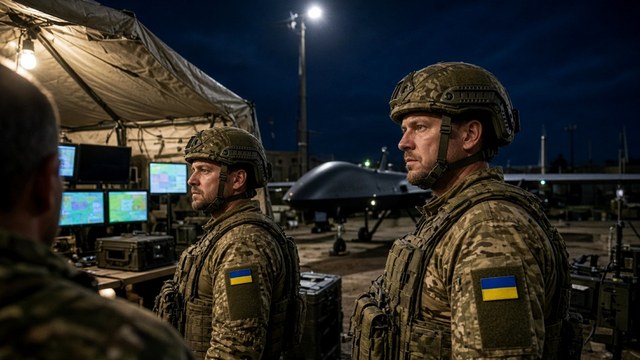
White House cuts Ukrainian drones off Starshield
16 October 2026Sudden speed caps disrupted battlefield drone flights before satellite links quietly returned19 sources
ECB Tracks Wage Risks as Energy Lifts Inflation
The European Central Bank kept its benchmark deposit rate steady at 2.50% following its September increase, as policymakers balanced stubborn inflation against sluggish growth. ECB President Christine Lagarde said high energy costs remained the primary driver of euro-zone price pressures, noting that officials were closely watching labor contracts for signs that wage increases might turn into persistent inflation.
Lagarde stressed that a secondary wage-price spiral had not taken hold, even as euro-zone inflation ran at 3.8% in September alongside Germany's confirmed 3.3% rate. The assessment showed that while rising energy prices limited the central bank's room to support growth, borrowing costs would remain elevated until core prices moderated.
Where things stand
By 05:00 UTC on October 15, European leaders faced mounting strains without losing operational control of their key institutions. Immediate risks remained concentrated in critical infrastructure and regional security: Black Sea commercial shipping faced drone attacks near NATO territory, while Russian missile strikes left hundreds of thousands of Ukrainian households without electricity. In Germany, coalition divisions and factory-gate inflation complicated Berlin's ability to drive continental growth, even as sovereign debt markets stayed calm and equity bourses managed small gains.
The ability of governments to navigate the coming weeks depends on several pending decisions: whether NATO expands patrols to protect Bulgarian maritime lanes, whether Ukraine can stabilize its power grid and maintain drone communications, and whether Chancellor Merz can secure funding for household energy subsidies. Long-term cohesion will be tested as Romania attempts to form a government, France tackles its fiscal deficit, and EU leaders gather to resolve disputes over industrial policy and the long-term common budget.
Who's involved
Friedrich Merz
German chancellor heading the CDU/CSU-SPD coalition government
goal → Cut electricity costs, steady public confidence and protect military aid for Ukraine
Baerbel Bas
Outgoing German labour minister and former Social Democratic Party co-leader
goal → Step down from office and party leadership following personal grief and political disputes
Alternative for Germany and BSW
German opposition parties aligning on state-level parliamentary initiatives
goal → Force Berlin to halt military assistance to Ukraine through regional pressure
Ursula von der Leyen
President of the European Commission
goal → Safeguard EU support for Ukraine while managing international trade disputes and energy strains
European Commission
Executive arm of the European Union responsible for drafting EU laws
goal → Balance urgent energy supply needs with climate regulations and long-term budget planning
Volodymyr Zelenskyy
President of Ukraine
goal → Secure allied military supplies, protect national power grids and advance EU membership
Russia
State carrying out the invasion of Ukraine
goal → Sustain military strikes against Ukraine while disputing blame for Black Sea naval incidents
Rumen Radev
Prime minister of Bulgaria
goal → Secure civilian shipping routes in the Black Sea and enlist expanded NATO air-sea patrols
Péter Magyar
Prime minister of Hungary
goal → Defend cross-border minority education rights while clearing Ukraine for further EU talks
Alexander Schweitzer
Incoming German labour minister
goal → Restore administrative stability and continuity to the federal labour portfolio
Lars Klingbeil
German finance minister
goal → Protect national budget rules while weighing the viability of energy-tax subsidies
Dimitar Stoyanov
Bulgarian defence minister
goal → Accelerate national entry into NATO coordinated anti-drone defence programmes