Stock Rally Masks Deep Global Strains
Shares rebounded on Friday, but elevated oil and emergency currency defenses signal persistent stress.
Later readings
Tech Boom Collides With Cost of Cash
15 October 2026Mounting debt worries and energy strains halt Asian markets despite record chip earnings.Oil Spikes and AI Fears Stalk China Export Surge
14 October 2026Mounting shipping attacks and tech valuation jitters offset blowout Chinese trade data across cautious global markets.Tech Selloff Shatters Fragile Global Market Calm
13 October 2026A steep plunge in Asian chip stocks and surging oil prices exposed deep cracks beneath Europe's brief equity rally.Oil Spikes as China Auto Slump Rattles Markets
12 October 2026Expensive crude and sinking Chinese demand tested global markets as tech investment offered a lonely cushion.
In a nutshell
Tense (−18) — calmer than the previous reading (−35 → −18, +17). Pressure: Emerging market currencies and debt (−42) and Energy complex (−36); support: European equities (+25) and Industrial metals (+18). The biggest swing: Industrial metals, +30 since the previous reading.
Highlights
- Industrial metals: +30 since the previous reading (−12 → +18)
The score of every gauge
−100 … +100- The needle starts at 0 at the top: right in blue for a plus, left in red for a minus, the ticks counting the way from 0; a dashed scale is quiet.
- Score — −100 maximum stress … +100 calm
Where the activity was
0–100| Energy complex | 97 |
|---|---|
| Emerging market currencies and debt | 96 |
| China economy | 87 |
| Central bank divergence | 85 |
| European equities | 82 |
| Major currency pairs | 79 |
| Industrial metals | 76 |
| Global technology | 73 |
| Other Asian markets | 69 |
| Financial services | 67 |
- How much happened to each gauge in this window, 0–100.
- Activity — 0–100
- Activity is not direction: a busy gauge can be calm, a quiet one tense.
From the Editor’s Diary
The busiest gauge: Energy complex — activity 97 of 100.
In short
Global stocks rallied to close the October 9 trading session, yet the advance failed to disguise severe underlying strains across energy, debt, and foreign exchange markets. While Europe's STOXX 600 climbed 1.03%, India's Nifty 50 jumped 1.30%, and the MSCI Emerging Markets index rose 0.60%, crude oil remained uncomfortably expensive. Brent settled at $104.72 a barrel after an intraday slide abruptly reversed on fresh supply anxieties.
Targeted policy moves delivered temporary relief without addressing core structural imbalances. China tapped 550 billion yuan in unused government debt quotas to fund local investment, and Brussels reached an initial understanding with Beijing to trim Chinese hybrid-vehicle exports while securing rare-earth supplies. But developing economies flashed unmistakable warning signs. The United Nations trade agency UNCTAD downgraded its 2026 global growth outlook to 2.6% from 2.9% in 2025.
By the close of the 24-hour cycle, India's central bank was forced into emergency action to shield the rupee, opening a dedicated dollar facility for state-run oil refiners. The sharp divergence between rising stock prices and defensive central bank intervention defines the current market landscape: financial channels remain open, but resilience across borders is deeply fractured.
Earlier readings
Oil Spikes, Bonds Tumble and an AI Flotation Collapses
9 October 2026Expensive crude and climbing borrowing costs rattled global markets as investors pulled back from risk.Costly Energy and Soaring Yields Batter Markets
8 October 2026Expensive oil, rising debt costs, and a surging dollar hit world markets despite record tech earnings.Oil Surge and India Rate Hike Spoil Europe’s Relief
7 October 2026Calmer European bond markets met fresh inflation shocks as crude topped $101 and New Delhi raised rates.Global Stocks Hold as French Bonds Fracture
6 October 2026Mounting French debt stress isolated Paris while world markets absorbed triple-digit crude.
Stories from this reading
EU finance ministers weaken single market watchdog
10 October 2026A deal in Luxembourg exempts major national stock exchanges and financial hubs from direct EU supervision.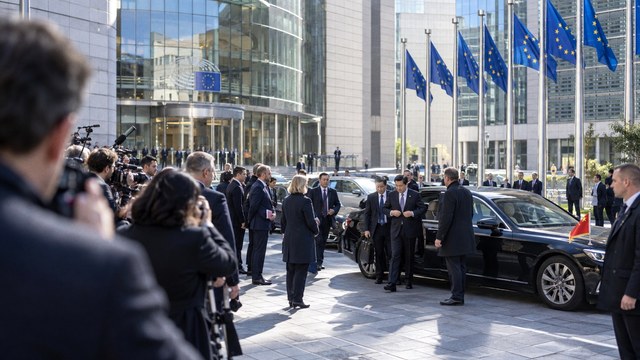
European Union weighs cap on Chinese hybrid cars
9 October 2026Officials in Brussels have not announced import limits, but news reports say talks could yield trade curbs after China rejected a voluntary ceiling.UNCTAD cuts world growth to 2.6%
10 October 2026The UN trade body warns energy shocks and debt will drag down output even as stock markets surge.
How it unfolded
Equities Rebound as Energy and Debt Pressures Linger
Global financial markets staged an uneven recovery during the 24-hour window from 07:00 UTC on October 9 to 07:00 UTC on October 10. Equities across Europe and parts of Asia advanced as immediate panic over energy prices and bond markets cooled.
Beneath that surface relief, the core macroeconomic stressors remained intact. Brent crude stayed firmly above $100 a barrel, European government borrowing costs stayed high, and Indian authorities launched direct market interventions to shore up the rupee.
Fresh fiscal spending in China and preliminary trade talks with Brussels offered temporary sentiment boosts, but a downbeat global growth forecast from the United Nations underlined that rising stock indexes do not signal a genuine economic acceleration.
European Bond Relief Fails to Clear Fiscal Doubts
European sovereign debt markets found some footing on Friday, bringing an end to days of aggressive selling. Yields—the effective interest rate governments pay to borrow on open markets—fell across the core economies, providing immediate breathing room to equity investors.
Germany's benchmark 10-year yield closed the week at 3.486%. France, however, struggled to escape investor scrutiny: deep domestic fiscal uncertainty kept the premium on French government paper wide compared with its German peer, even as the broader market settled.
The European Central Bank held rates steady throughout the session, leaving sovereign yields to reflect fundamental credit risks. What changed was the threshold of relief: lower borrowing costs cheered stock traders, but high energy import bills and rigid government debt loads left the eurozone's medium-term outlook as fragile as before.
London Stocks Gain While Currency Vulnerabilities Persist
In London, the blue-chip FTSE 100 index climbed 1.06% to finish at 10,552.05, tracking a pullback in government bond yields, or gilts. The retreat in sovereign borrowing costs eased pressure across corporate balance sheets.
Sterling gained ground during the morning trade, firming to roughly $1.324 against a softer dollar. That advance remained brittle, however, because Britain's dependence on imported energy left the pound acutely exposed to swings in international crude and volatile debt benchmarks.
Market sentiment showed clear limits. Airtel Money began conditional dealings in London only to fall below its initial public offering price, proving that index-level gains would not automatically float individual new listings. What changed was market selectivity: while established large-cap equities rallied, capital stayed cautious toward unproven market entrants.
Broad European Equity Advance Meets Sharp Telecom Selloff
European equities enjoyed a broad-based rally as the pan-European STOXX 600 gained 1.03% to 631.95, Germany's DAX climbed 1.13% to 25,087.27, and France's CAC 40 added 0.95% to 7,803.33. Basic resource producers paced the gains with a 2.99% surge, while carmakers found support in diplomatic progress between Brussels and Beijing.
The rally came with a severe sector fracture. Telecommunications shares tumbled roughly 2.9% across the continent after investors suddenly repriced the competitive threat posed by direct-to-cell satellite communications networks. Deutsche Telekom sank 7.9% in heavy trading.
What changed was the market's assessment of defensive safety: traditional telecom cash flows, long prized for stability, were repriced on disruptive technology risks, dividing an otherwise buoyant market between cyclical winners and vulnerable legacy providers.
Deutsche Telekom drops 8% as SpaceX expands
10 October 2026Cheaper oil and car talks lifted European shares, but satellite competition punished phone carriers.3 sources
Warsaw Political Feud Clouds Polish Central Bank Authority
Regional governance concerns deepened in Eastern Europe after a Polish parliamentary panel recommended trying central bank governor Adam Glapinski before the State Tribunal, the constitutional court that handles high-ranking officials. The committee alleges misconduct and breaches of statutory independence.
Glapinski has denied any wrongdoing, and the committee's vote serves only as an initial recommendation rather than a formal sanction. A binding trial still requires an explicit vote by the full Polish parliament, or Sejm.
The move introduced legal friction to monetary policy management in the region. What changed was the institutional risk profile: escalating political scrutiny over the central bank injected fresh governance doubts into Poland's sovereign debt and currency markets, leaving foreign investors to evaluate whether policy credibility could erode.
Beijing Deploys Debt Quotas and Strikes European Trade Pact
Beijing intervened directly to support its cooling economy, unlocking 550 billion yuan, or about $82 billion, from previously dormant local-government borrowing quotas. The Ministry of Finance directed 300 billion yuan toward district and county administrative budgets, leaving 250 billion yuan to finance capital works amid persistent real estate weakness.
Hours later, Chinese and European officials announced a preliminary breakthrough: Beijing agreed in principle to halve hybrid-vehicle shipments to Europe in return for improved market access and expedited licensing for critical rare-earth elements. The diplomatic compromise followed earlier friction where the EU weighs hybrid-car safeguard rules to protect domestic factories.
The offshore yuan settled near 6.6922 per dollar as markets absorbed the twin measures. What changed was the trade perimeter: China bought vital fiscal breathing room and defused an immediate commercial dispute with Europe, even though the pact remains a preliminary framework rather than a binding treaty.
China unlocks $82 billion in debt quotas
10 October 2026Beijing released unused borrowing limits to rescue local budgets while offering car export cuts to calm European trade disputes.2 sources
Persistent Yen Slide Overshadows Muted Tokyo Session
Japanese cash markets had concluded their trading session before the European monitoring period began, leaving the Nikkei 225 index down an imperceptible 0.02% at 69,030.92.
The real pressure materialized in foreign exchange trading, where the dollar climbed steadily against the Japanese currency to reach 158.34 yen by the end of the day. With no policy action or currency intervention from the Bank of Japan, Tokyo's financial narrative remained tethered to currency depreciation.
What changed was the international cost calculation: the yen's inability to stage a rebound alongside broader Asian equities highlighted how wider global interest rate differentials continue to draw liquidity out of Japan.
Indian Equities Rally While Indonesia Readies Market Backstop
India's Nifty 50 advanced 1.30% to 22,520.45, lifted by consumer staples and technology exporters. The equity advance occurred even as monetary officials faced mounting liquidity pressure that would soon force central bank intervention.
In Jakarta, Indonesia's sovereign investment fund Danantara disclosed that it had already deployed $3 billion into public markets and stood ready to purchase domestic equities during sharp market downturns if valuations warranted. The announcement was a conditional framework rather than an active intervention.
What was once a clean emerging-market recovery now hinged on state balance sheets. What changed was the balance of market forces: equity rallies in emerging Asia increasingly coexisted with administrative efforts to prevent capital flight.
Brazil Cuts Gasoline Levies as Emerging-Market Growth Diverges
Brazil moved to shield consumers from high fuel costs, trimming federal gasoline taxes by 0.89 reais per litre and widening subsidies for imported diesel. The fiscal concessions came right ahead of the country's presidential runoff vote, shifting the burden of the global energy shock directly onto the state budget.
The move coincided with a sobering outlook from UNCTAD, the United Nations conference on trade and development. The agency projected Brazilian economic growth at just 1.8% in 2026 and 1.5% in 2027, lagging behind projections of 7.3% for India and 4.5% for China.
What changed was Brazil's fiscal room for maneuver: Brasília absorbed the consumer impact of high oil prices, but at the cost of worsening sovereign finances while its domestic growth engine slowed.
Zambia Secures Preliminary IMF Aid in Tough Debt Climate
Zambia reached a staff-level agreement with the International Monetary Fund on a three-year, $1.5 billion Extended Credit Facility, marking a crucial step for the copper producer as it rebuilds financial credibility following a sovereign debt default.
The preliminary pact provides an essential signal for external creditors, though funding remains subject to formal ratification by the IMF's executive board. While the Fund projected Zambian growth at 5.6% for 2026, it warned that weak tax collection and high spending could jeopardize fiscal recovery.
A parallel UNCTAD study underlined the uphill battle facing frontier economies, showing how elevated international interest rates drain resources from developing nations. What changed was Zambia's financing path: staff endorsement opened the door to fresh multilateral capital, but spending conditions will limit domestic policy flexibility.
India Unveils Emergency Dollar Window to Defend Rupee
The hinge moment of the trading window arrived when the Reserve Bank of India deployed direct emergency measures to halt a steep currency decline. With the rupee down more than 7% in 2026 and trading near 97 per dollar, the central bank had initially auctioned 250 billion rupees in sovereign bonds and raised commercial banks' daily cash-reserve compliance to 99% from 90% to soak up rupee liquidity.
When those steps proved insufficient, policymakers crossed a threshold: the central bank opened a dedicated foreign exchange window to sell dollars directly to three state-run oil refiners, stripping heavy corporate demand out of the open market while curbing speculative currency hedging.
The intervention followed an earlier weekly tracking report showing investors had pulled $752 million from emerging-market equities while steering $1.48 billion into bonds during the week through October 7. What changed was the operational reality for India's currency: the central bank stepped in as direct dollar provider to the energy sector, acknowledging that open market mechanisms could no longer defend the rupee on their own.
Brent Reverses Midday Drop to Finish Above $104
Crude markets provided the definitive commodities shock of the cycle. Early European trading saw prices slide as market participants priced in easing military risks around Iran and anticipated fresh Chinese refined fuel exports.
That brief selloff unraveled as hurricane-driven production halts in the Gulf of Mexico disrupted supplies. Buyers rushed back into futures contracts, lifting global benchmark Brent crude to settle at $104.72 a barrel, up 0.42%, while U.S. West Texas Intermediate settled at $91.85.
What changed was the inflation baseline: by wiping out earlier losses and holding above $104, crude oil ensured that headline import costs, transportation expenses, and foreign-exchange pressures will remain elevated across energy-dependent economies.
Gold Climbs Past $4,190 Amid Continuing Currency Volatility
Precious metals gained as bargain hunters stepped in following recent retreats. Spot gold rose approximately 1.5% to $4,194.36 an ounce in Reuters pricing by 19:29 UTC, with subsequent spot indications hovering near $4,196.
Silver and platinum mirrored the rebound, advancing to roughly $60.77 and $1,685.64 an ounce. The buying underscored persistent demand for real assets against a backdrop of sovereign currency strains.
What changed was investor positioning: while bullion recovered lost ground, stiff competition from high bond yields and an erratic currency landscape ensured that price volatility, rather than a steady upward trend, remains the defining condition for precious metals.
Where things stand
By 07:00 UTC on October 10, the global financial landscape pointed to an uneasy balance. Equities across Europe and Asia had stabilized, industrial metals and gold had pushed higher, and the initial trade compromise between Brussels and Beijing showed that commercial diplomacy was still functional. Yet the underpinning forces remained fragile: Brent crude held above $104, the euro and yen remained weak against the dollar, and India had been forced to establish an emergency currency window for state refiners. UNCTAD's lowered 2.6% growth outlook reinforced the growing divergence between rallying asset prices and a slower real economy.
The immediate horizon will test whether crude supplies and shipping routes can normalize, whether India's dollar window shields the rupee without draining state resources, and whether China's fiscal quotas translate into physical demand. At the same time, markets will scrutinize sovereign bond sales in Paris and London, European capital market legislation, and final board approval for Zambia's IMF facility. The end-of-week rally verified that exchange mechanics continue to work, but it left the deeper question of global debt and energy sustainability entirely unanswered.
Who's involved
Reserve Bank of India
The central bank of India, managing the national currency and money supply
goal → Squeeze speculative dollar hoarding, defend the tumbling rupee, and stabilize domestic cash reserves
China's Ministry of Finance
China's cabinet department overseeing national fiscal policy and public spending
goal → Reallocate unused borrowing quotas to stimulate local governments, infrastructure projects, and internal demand
European Commission
The executive branch of the European Union that negotiates international trade
goal → Safeguard European manufacturers against price undercutting while locking in reliable supplies of vital Chinese minerals
China's Ministry of Commerce
The government body managing China's foreign commerce and trade licensing
goal → Maintain export access to European consumers while managing trade caps and critical-material authorizations
UN Trade and Development
The United Nations agency evaluating global trade patterns and emerging-market finance
goal → Deliver realistic forecasts on slowing global expansion and highlight borrowing disparities among developing nations
International Monetary Fund
The Washington-based lender of last resort for distressed sovereign nations
goal → Finalize a multi-year loan package to shore up Zambia's financial system and support economic stability
Government of Zambia
The executive authority of Africa's leading copper-mining nation
goal → Secure international credit lines to spur development without triggering another sovereign debt crisis
Brazilian government
The federal administration of Latin America's largest economy
goal → Buffer household budgets from soaring fuel import costs by granting temporary tax breaks
European Union finance ministers
Government ministers overseeing fiscal rules across the 27-nation European bloc
goal → Unify fragmented national capital markets while preserving member-state regulatory powers
National Bank of Poland
The monetary authority setting interest rates for Poland
goal → Defend its institutional autonomy as lawmakers pursue disciplinary proceedings against its chief
Danantara
Indonesia's newly formed state investment fund managing public assets
goal → Deploy sovereign capital into undervalued domestic shares during heavy market downturns
International commodity traders
Commercial firms and financial desks buying and selling raw physical materials
goal → Re-evaluate price exposure across oil, metals, and crops as supply shocks clash with tightening liquidity